


Few commercial airplanes that have flown through the sky have had a shape as particular as the Airbus Beluga, named for its nose so similar to that of the cetacean from which it takes its name. However, despite escaping the perception we have of aerodynamic shapes, its lines made all the sense in the world given its function: carrying large pieces, specifically airplanes. It was an essential aircraft for making airplanes in Airbus logistics.
The beluga became small. With a payload capacity of 47 tonnes and space to accommodate items up to 30 meters in length, the A300-600ST had the capacity to accommodate one wing per trip. However, the new BelugaXLs fit two wings. The company explained that with an increase in manufacturing and its just-in-time logistics, this change represented a before and after in the efficiency of its logistics.
For example, for operations such as taking the wings manufactured in Broughton (United Kingdom) to the assembly lines in Toulouse (France) or Hamburg (Germany). By increasing the production rate, with the old Belugas they needed either more ships or more flight hours to meet deadlines. So the half-dozen BelugaXLs became the official ships for Airbus logistics.
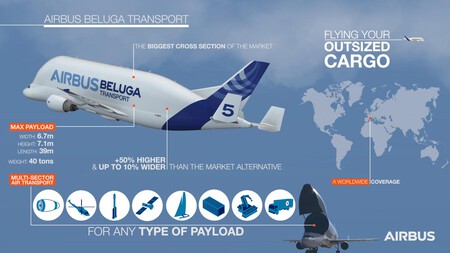
Airbus infographic to explain the second life of the BelugaST
The second life of the Belugas. Designed to last about 40,000 flight hours and entered service in 1995, back in 2022 Airbus estimated that these units retired for its own logistics still had up to 20 years of life left, so it gave them a new mission: to be delivery planes through the new cargo airline they created for the occasion, Airbus Beluga Transport (AiBT). In November 2023 they obtained their air operator certificate to operate.
In this way, they would cover a specific niche: high-capacity air delivery, aimed at transporting satellites, aircraft engines, helicopters or heavy machinery. The timing was ideal as the huge Soviet Antonov An-124s that were traditionally used for this type of deliveries had been recovered for the fight between Russia and Ukraine. The market did not think the same: approximately a year later it closed the business due to lack of demand.
Only one remains operational. Of the five BelugaSTs that existed, only one remains in service: the one with registration F-GSTC “3”, the rest have been retired or are awaiting destination. The first (registration F-GSTA “1”) was retired in Bordeaux on April 21, 2021, the same city in which the F-GSTB “2” said goodbye on December 18, 2025. The F-GSTD “4” retired in Toulouse on September 17, 2025 and the fifth said goodbye in Broughton on January 29. F-GSTF “5” is the only one for which we know a clear destination: it will become an interactive classroom for STEM studies in the UK.
Spain repeats mistake. As already happened with its predecessor the Super Guppy, it seems that Spain will not keep any Beluga either. At the time he was due for a Super Guppy, but they ended up rejecting it due to lack of space at the Getafe Air Museum. The plane was sold to NASA and still flies. The prototype of the A400M that was in Seville did not have good luck either: it ended up being scrapped while its brothers are on display in the French Aeroscopia museum or in the Airbus factory in Bremen.
In Xataka | The triangles on the plane window are not for decoration: they are a quick way to check that the flight is going well
In Xataka | We believed that everything happened because of the new fighters. The F-16 has been in the air for 50 years and continues to sell like hotcakes
Cover | Brian Bukowski, CC BY-SA 2.0 via Wikimedia Commons

