


The story of skywell in Spain it has been as brief as it is disappointing. The Chinese brand, which emerged with great expectation at the beginning of 2025 promising affordable and quality electric vehicles, has disappeared from the map practically without making a noise.
Without an official statement explaining the reasons, the reality is stark: its official website in our country no longer works and a simple Google search reveals that the Skywell Spain offices appear as “permanently closed“What began as an ambitious commitment to sustainable mobility ends with a minimum balance: barely 8 registrations throughout the year 2025 -5 units of the BE11 and 3 units of ET5-.
This data, taken from official sales statistics, summarizes better than any statement the failure of an operation that generated enthusiasm among those looking for affordable alternatives to the electric car. For drivers and companies that had placed their trust in the brand, the closure represents not only disappointment, but also uncertainty about the future of after-sales service and the availability of spare parts.
A technological giant that burst in strongly… and faded away
Skyworth, the technology conglomerate founded in 1988 and listed on the Shanghai Stock Exchange, is not a newcomer to the automotive world. In 2010 it created its automotive division skywellspecialized in the development of electric vehicles for the transportation of people and commercial logistics. Since 2020, the company has progressively expanded its range, making the Skywell BE11 in its flagship model.
This compact SUV had already demonstrated its potential in markets such as Türkiye, Germany, Israel, Russia, Mexico, Ecuador and Cuba, where they have sold a lot. In Spain, the brand arrived from the hand of a Navarrese importer with more than 35 years of experience in the sector, with a spare parts warehouse in Pamplona and plans to open another in Madrid.
The reception from the Spanish market was much more lukewarm than expected. Competitive prices, attractive warranties (8 years on the battery and 5 on the complete vehicle) and technical specifications were not enough to generate the necessary sales volume.
Only 8 registrations in 2025: a result that speaks for itself
The registration figures for all of 2025 are devastating. Skywell registered only 8 units sold in Spain during the entire year. A testimonial volume that contrasts with the initial expectations of expansion and with the success that the same brand had achieved in other countries.
This data highlights the real difficulties that new Chinese brands face in our country.
The Skywell BE11: the only model that arrived… and was not convincing enough
He Skywell BE11known internationally as Skyworth K, was the only vehicle that was actually marketed in Spain. It was a compact SUV 4.7 meters long with a spacious cabin and a trunk of between 467 and 1,141 liters (up to 1,147 liters in some configurations). Available in four colors and two finishes (Comfort and Luxury), it had a front electric motor of 204 HP and 353 Nm of torque.
The battery versions 72 kWh They offered some 400 km of WLTP autonomy, while the Long Range variant of 86 kWh reached the 477-500 km. The starting price was around €40,900 (before applying up to €7,000 in aid from the Moves Plan), although in the first months more aggressive promotions were announced.
The equipment was generous even in the base trim: LED headlights, 6 airbags, advanced driving assistance systems, 12.8-inch touch screen and digital instrumentation. The Luxury added a panoramic roof, wireless charging, 220V V2L socket and 360º cameras.
The three new models that never arrived in Spain
At the Mondial de l’Auto 2024 in Paris, Skyworth had generated great excitement by revealing three new models that should complement the BE11 and reinforce its presence in Europe:
- Skyworth Hongtu: a light commercial van available in six different configurations, with lengths between 4,990 mm and 5,990 mm. Specifically designed for professional transport and logistics, its arrival in Spain was scheduled for the end of 2025.
- Skyworth Y (Skyhome in Europe): a sedan with a sporty and futuristic design with opposing doors, a large curved rear screen, camera mirrors and aerodynamic wheels. A premium model aimed at drivers looking for elegance and advanced technology.
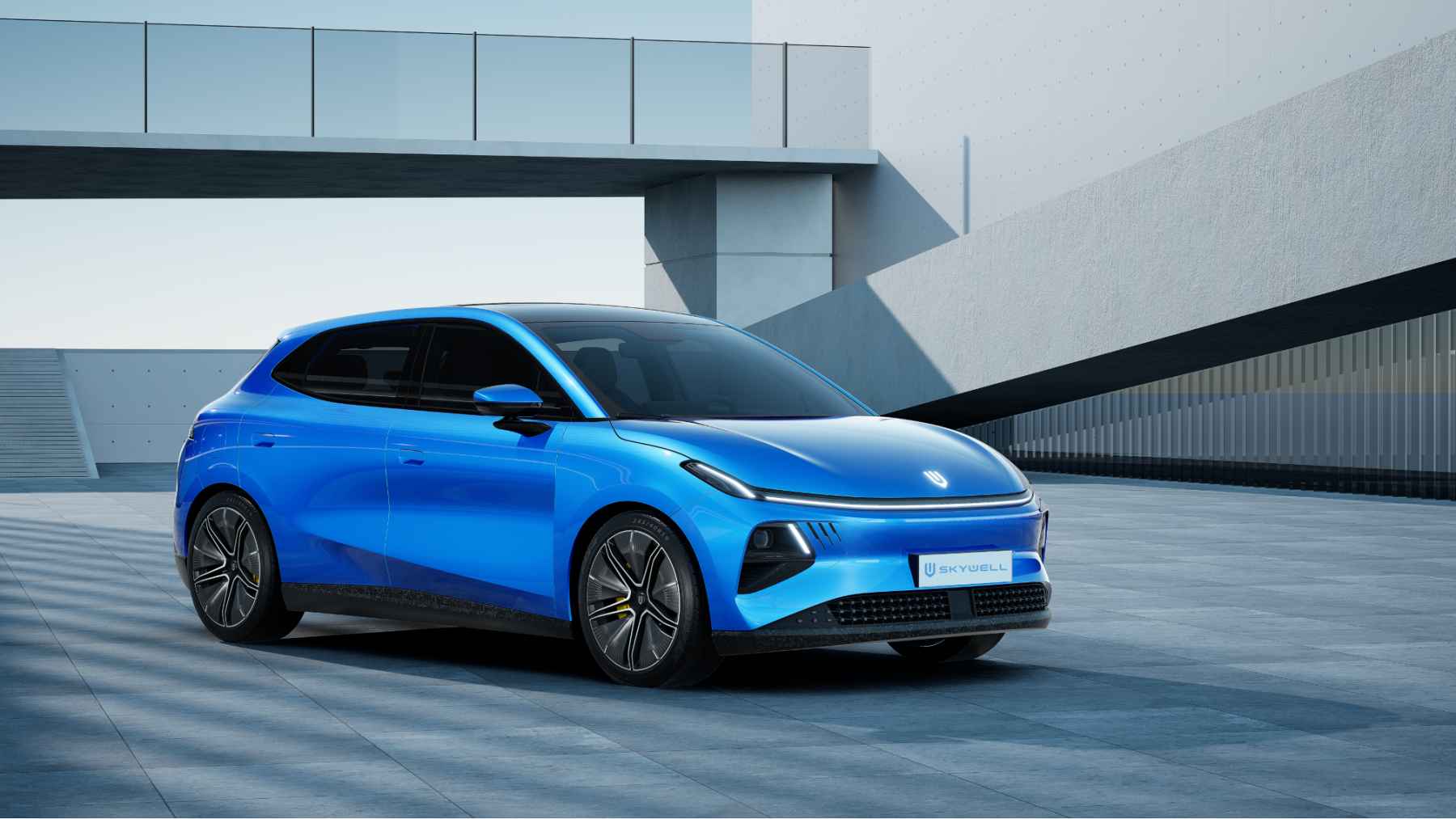
- Skyworth Q: a compact B-segment hatchback that promised to be one of the most affordable options on the electric market, with prices from €25,000 and autonomy of up to 400 km thanks to 65 and 80 kWh batteries. Its arrival was also expected by the end of 2025.
None of these three models ever materialized in the Spanish market. The announced expansion remained simple presentations at international fairs and promises that were never fulfilled.
Uncertainty for the few owners and the future of the brand
The few buyers who opted for the Skywell BE11 in 2025 now find themselves in a complicated situation. Although the brand had highlighted its after-sales network and spare parts delivery times, the closure of the offices and the inoperative website raise legitimate doubts about the long-term maintenance of these vehicles.
There is no official information on whether any distributor will undertake the service or on the warranty on the batteries. For those who were already driving their BE11, the experience has gone from excitement to concern in a few months.
The hidden risks of betting on newly arrived Chinese brands
This Skywell case brings to the table an uncomfortable reality that many buyers prefer to ignore when they allow themselves to be seduced by attractive prices, generous equipment and promises of technology: the real dangers of buying a car from a Chinese brand that has just landed in Spain and Europe.
It’s easy to get carried away by the emotion of the moment. A well-equipped electric SUV for less than the cost of an equivalent European model seems like a unique opportunity. However, the Skywell story shows that behind that seemingly unbeatable offer may hide a significant risk.
If the brand suddenly decides to close down and leave the country, the owner can literally be left with a “paperweight with wheels” very expensive. A modern vehicle that, overnight, loses a large part of its resale value, is left without an official technical assistance network and, most worryingly, without a real guarantee of spare parts supply in the medium and long term.
This is not a hypothetical scenario. In recent years, several Chinese brands have strongly entered the European market. Some have managed to establish themselves, but others have disappeared as quickly as they arrived, leaving their clients in a complicated and expensive situation.
Experts advise carefully evaluating, before signing any purchase, not only the performance and price of the vehicle, but also the track record and solidity of the importer, the real extension of the dealer network, the spare parts logistics capacity and the consolidated presence of the brand in other European countries.

