


Alejandro González Iñárritu is on tour in Mexico City to celebrate the 25th anniversary of the release of his first film, Love Dogsa film that not only changed his career and that of many of those who participated, but also marked a milestone in Mexican culture. The possibility of seeing unreleased material from the film, the parties that have brought together former collaborators – now stars of cinema, literature and music -, and the opportunity to see the film again in cinemas have charged the cultural field with emotion and have provoked a reflection on the extraordinary political, social and economic conditions that gave rise to the film: the end of the PRI, the emergence of the Zapatista Army of National Liberation and the reforms neoliberals, among others. Critics, producers, collaborators of the film and the director himself reflect on the changes that made this milestone possible.
The tributes began last May at the Cannes Festival, with the screening of the restored version of the film. On September 18, the Fondazione Prada in Milan opened the exhibition Dream Dog. celluloid installation (his third collaboration with González Iñárritu), which brings to light never-before-seen material from the film, stored in the archives of the National Autonomous University of Mexico. The exhibition opened in Mexico on October 5 at the Lago Algo center in Chapultepec, with an epic party in which Julieta Venegas sang and Meme del Real and Quique Rangel, from Café Tacvba, played.
The Mubi platform will put the film online and will release a 35 mm version for theaters in Mexico and other Latin American countries. On October 6, the Ministry of Culture, the National Institute of Fine Arts and the Mexican Institute of Cinematography joined the festivities with a screening at the Palace of Fine Arts and a concert by Gustavo Santaolalla, the composer of the film’s original band.

Nearly 1,300 people attended the Palace of Fine Arts to see the film again, framed by the monumental experience of that auditorium. The screening served to applaud the actresses, actors and producers and to witness the hug between the screenwriter Guillermo Arriaga and González Iñárritu, who had distanced themselves after the film Babeltheir third collaboration, and they saw each other again after 20 years before the eyes of moved spectators.
The tribute to Love Dogs It has also invited reflection on the political, social, economic and cultural conditions that made it possible. Juan Villoro, who participates in the Milan exhibition with a sound and visual story, has called that Mexico of 2000 as the moment when something exploded.
“At the end of the nineties, we felt an air of change,” says González Iñárritu. “Everything was illusory, but at least it felt that way. The PRI, after seventy years of partisan dictatorship, was breaking down. The walls of communism were falling and globalization promised to be the solution to the injustice and disparity of the world. At the same time, Marcos and the Zapatista movement exploded in Chiapas and put the plans of Salinas and the financial cartels at the forefront, putting Mexico in the world’s sights”
In addition to these political circumstances, the material conditions of cinema were also changing. In his book, Screening Neoliberalism (Vanderbilt, 2014), the Mexican critic Ignacio Sánchez Prado says that Love Dogs and other films from those early years of the 2000s, which had extraordinary international success, are the product of the deterioration of the nationalist discourse of previous years that freed filmmakers from painting social types and the discovery of the middle classes as an audience.
Alejandro González Iñárritu had built a successful career as a radio host, first, and as a publicist, later. He knew the middle-class audience very well for having introduced rock to urban listeners and making fresh advertising aimed at the same audience, but it was not clear that he, precisely, was going to be such an important vehicle for change in Mexican cinema.
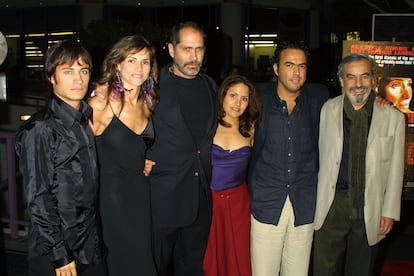
Rodrigo Prieto, the film’s photographer, says that he met Alejandro González Iñárritu during those years. He began to collaborate as director of photography for several campaigns and became his friend. After a few years of collaboration, he began to notice that his campaigns became a little more complex, as if they were small dramas. “It wasn’t so much these crazy comedies anymore,” says Prieto, “but there were stories, like little movies.”
For this reason, Prieto told González Iñárritu that he would like to be the photographer if he made a feature film. González Iñárritu told him that he was precisely working with a script by Guillermo Arriaga and sent it to him. “It caught my attention,” says Prieto. “I didn’t expect that the first thing Alejandro was going to direct would have that level of complexity, that he would commit to making a portrait with that sordidness. I was surprised and also excited because it was an opportunity to go in a different direction than what I was doing.”
Make reality of Love Dogsthe most expensive film ever produced, also required a complete change in the production paradigm. “We set out to create equitable conditions for the production of our cinematography, which would allow it to compete in the market with productions from other countries; this implied, among other things, having more shooting time and more negative footage, as well as more months of editing, all of which raised the budget to double the average national productions of that time,” says Mónica Lozano, associate producer.
The film premiered on May 14, 2000 in Cannes. in the book Love Dogs, Published by Mack Books regarding the exhibition at the Fondazione Prada, González Iñárritu remembers the anxiety and uncertainty of that projection. “Guillermo Arriaga, his wife Maru and I waited anxiously outside, I smoked half a pack of cigarettes. I was a nervous wreck. People started arriving three minutes before the opening credits of the film started rolling. The room was 70 percent full. During the screening, people were talking on their cell phones and about an hour later, a dozen people started heading to the exit, one by one.”
It turned out that it was a common festival experience. In reality, González Iñárritu had made a film with an innovative narrative, which portrayed violence in Mexico City at the beginning of the 21st century, painted characters full of life, tender and terrible, and used a raw and visceral aesthetic. Its soundtrack was exceptional and the collection of music by Mexican bands that accompanied the film established a mark in local production. Love Dogs It won the awards at Cannes, the BAFTA award in the United Kingdom and was nominated for best foreign film at the Oscars, among other recognitions.
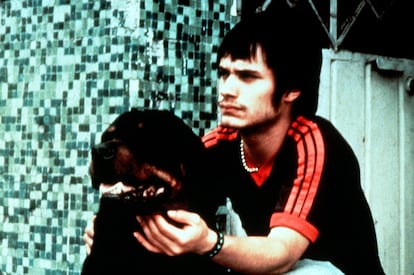
The international success of Love Dogs It left everyone with a feeling that something had also changed in the role of Mexican culture on a more global level. Suddenly, Mexican society began to produce very successful cultural objects. They were made with the rules of international language, but they still talked about local affairs.
“In the nineties,” says Ignacio Sánchez Prado, “we thought that Mexicanidad was finished because it was connected to the fall of the PRI, the State and what Roger Bartra called, the imaginary networks of political power. In reality, a very peculiar thing happened: cultural Mexicanidad became a global commodity in an unexpected way. Elite Mexican culture became hooked on the transnational networks of cultural commerce and generated an interest almost unprecedented.”
Alejandro González Iñárritu expresses a very similar idea. “25 years later,” he says, “people around the world and across many generations still mention Love Dogs as one of their favorites or they tell me that it was a film that made them be filmmakers, artists or make certain decisions in life.”
The celebration of 25 years of Love Dogs It is a double opportunity, according to Sánchez Prado. On the one hand, “they open the opportunity to think about the film as a historical document, as a reflection of a way of thinking in Mexico and in Mexican society, and on the other, to think about a utopian possibility of Mexican cinema. We have to imagine what conditions are needed in Mexico to produce cinema of that quality again, what it means to make national and transnational Mexican cinema that is socially relevant for us.”

