


Image source, NASA/Getty
-
- Author, Drafting
- Author’s title, BBC News World
-
-
Reading time: 7 min
The four astronauts of the Artemis II mission are now safe on Earth after a splashdown that NASA described as “textbook.”
At 8:07 pm ET, the Orion capsule splashdown in the Pacific Ocean, off the coast of San Diego, as scheduled by NASA.
The US space agency said it was a “textbook” landing.
In the live broadcast, an announcer could be heard saying that the four astronauts are “in excellent condition.”
“Everyone is in excellent shape,” he noted.
Later, when rescue boats in the Pacific reached Orion, a medical officer who entered the capsule to check on the astronauts’ health reported that all four crew members were “in the green.”
“‘In green,’ meaning they feel great, not the color of their skin,” joked Megan Cruz, speaking on behalf of NASA from the USS John P. Murtha, the ship responsible for the astronauts’ rescue.

Image source, POT
The return of the Artemis II mission began at 2:53 pm with an eight-second thruster burn. This maneuver adjusted the ship’s trajectory millimeters to guarantee a safe descent.
Shortly after 7:30 p.m. the crew module separated from the service module, exposing the vehicle’s heat shield just before colliding with Earth’s atmosphere.
“For the past 10 days, the cylindrical service module has been the workhorse of the mission,” explained BBC Science Correspondent Pallab Ghosh.
“Its engines performed the maneuvers that sent Orion on a trajectory around the Moon. Its solar panels generated the power that kept the crew alive and its propulsion system pushed the craft on a trajectory homeward through 230,000 miles of empty space,” he added.
The most critical phase of this return began at 7:53 pm It is estimated that aerodynamic friction subjected the astronauts to gravitational forces of up to 3.9 G, while the intense heat formed a layer of plasma at about 1,650 ºC around the capsule.
As it hurtled through the atmosphere, Orion’s heat shield was exposed to temperatures of around 2,700°C, about half the surface temperature of the Sun.

Image source, Reuters
This fiery barrier blocked all radio communications. The mission control center lost full contact with the spacecraft for about six minutes.
At 8:03, an automatic system began deploying the parachutes. This progressively reduced the speed of descent to about 32 kilometers per hour before hitting the water.
Ditching occurred at 8:07 pm, as planned.
A military and rescue team was waiting for the astronauts in the Pacific.

Image source, POT
After the impact, boats with specialized personnel went to the place where Orion was floating to help the astronauts get out of the capsule and onto an inflatable raft.
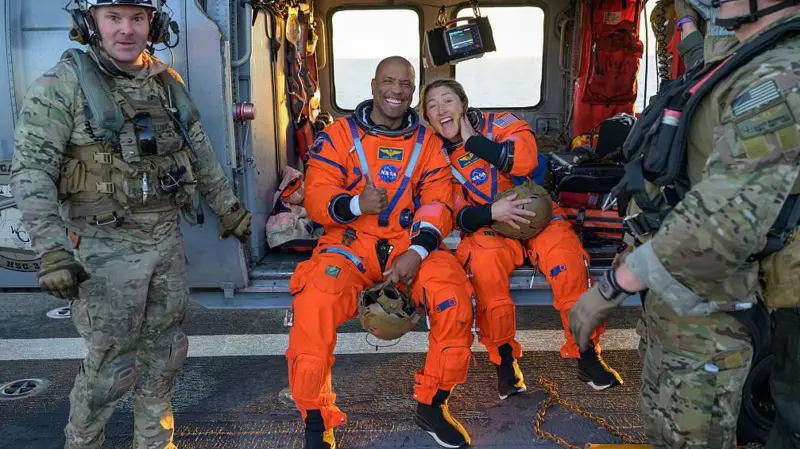
The crew of the Artemis II were then flown by helicopter from the ocean to the amphibious ship USS John P. Murtha, where they received medical checkups.
Time in space is physically exhausting, but a NASA official declared that the astronauts were “happy and healthy.”
The focus now will be on reuniting them with their families.

Image source, NASA/Getty
The end of a historic journey
The landing in the Pacific concluded a journey of ten days and more than 1.1 million kilometers in distance. American astronauts Reid Wiseman, Victor Glover, Christina Koch and Canadian Jeremy Hansen traveled deeper into space than any other human being in history.
The group woke up on its last day in orbit more than 98,000 kilometers from Earth. They leave behind a tour where they flew over the far side of the Moon and even had a live conversation with President Donald Trump.
The capsule’s arrival marks the end of the first manned lunar voyage in more than half a century. The four explorers opened the door for humanity’s future return to the surface of our natural satellite.
That idea was expressed this Friday by a very emotional Jared Isaacman, the administrator of NASA, who described how seeing the crew of this mission land left him speechless.
“My childhood Jared can’t believe what he just saw. This is just the beginning,” he said.
“We are back in the business of sending astronauts to the Moon and bringing them back safely,” he added.

Image source, POT
After the return of the astronauts, US President Donald Trump published a welcome message.
“Congratulations to the Great and Very Talented Crew of Artemis II. The entire trip was spectacular, the landing was perfect and, as President of the United States, I couldn’t be more proud. I hope to see you all soon in the White House. We will do it again and then, the next step, Mars!” he wrote in a message on the Truth Social network.


What atmospheric re-entry really feels like
By Helen Sharman, UK’s first female astronaut
I know what the Artemis II crew experienced.
After days floating in weightlessness, re-entry was a brutal return to normality for me.
As our capsule hit the top of the atmosphere, the gentle silence of orbit gave way to a growing roar and ferocious vibration. The ship began to shake, the G-forces increased, and I felt crushed against my seat.
I remember trying to pick up our reentry manual and being surprised by how heavy it felt; even moving my little finger required effort.
Every small movement suddenly required work, as if gravity “switched on” again.
Still, she was too focused to feel afraid: eyes on the screens, waiting for each milestone to happen, trusting in the heat shield she couldn’t see.
I knew it was going to be tough, but I also knew it would only last a few minutes before the parachutes opened and the descent smoothed out.

Subscribe here to our new newsletter to receive a selection of our best content of the week every Friday.
And remember that you can receive notifications in our app. Download the latest version and activate them.

