

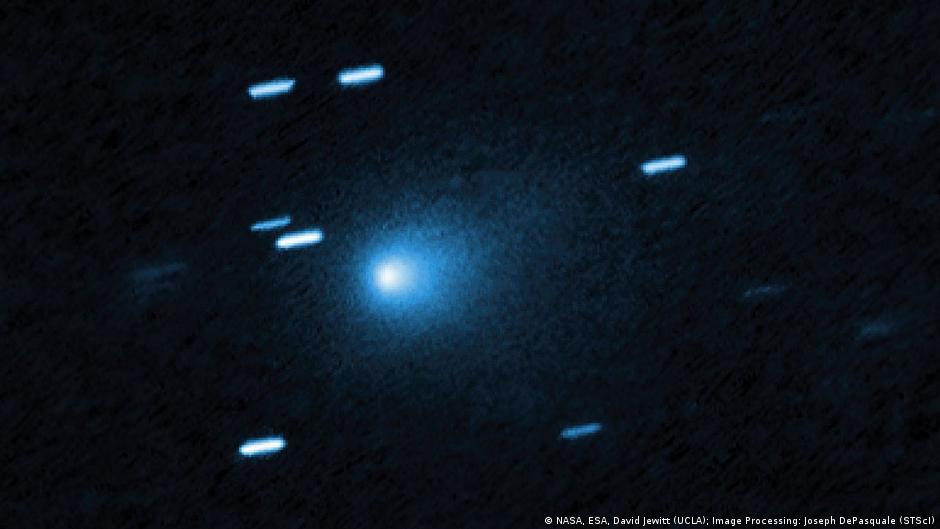
Those who have been following the journey of the interstellar comet 3I/ATLAS for weeks feel that a certain wait is about to end.
This Wednesday, November 19, NASA will reveal to the public a series of never-before-seen images of the enigmatic cosmic visitor, only the third known object to reach our solar system from the depths of interstellar space.
The presentation is scheduled for 3 pm EST (20:00 UTC) from the Goddard Space Flight Center, in Greenbelt, Maryland, where the agency will show images to the public that had not been shared until now.
The delay in publishing these observations had nothing to do with a lack of data or fanciful theories suggesting an extraterrestrial spacecraft.
The reason was much more earthly: most NASA personnel were out of service during the US government shutdown between October 1 and November 12.
This administrative hiatus occurred in the middle of a critical stretch of the comet’s journey and left the agency without the ability to communicate with the public at a key moment.
The perihelion of the interstellar comet
And 3I/ATLAS has starred in decisive moments during these weeks of silence. On October 29 it reached perihelion – its closest point to the Sun –, when comets usually show their greatest activity.
These “dirty snowballs,” as they are colloquially known Because they are masses of rock and ice, they release spectacular gases when solar heat sublimates their frozen surface, creating the characteristic tails of vapor and ions. The problem: from Earth, the comet was hidden behind the Sun at just that critical moment.
Observations from Mars
However, all was not lost. On October 3, the interstellar visitor passed just 30 million kilometers from Mars, where a fleet of spacecraft awaited.
The European Space Agency already published images captured by its ExoMarsTrace Gas Orbiter and the Mars Express on October 7.
In the images, the comet is barely visible as a small luminous blur, something logical if we remember that these probes are optimized to look closely at the surface of Mars and not to follow fast objects at enormous distances.
Even so, the data made it possible to detect an envelope of ionized gas around it, the typical “atmosphere” that accompanies natural comets.
Furthermore, according to Live Science, By combining this data with ground observations, scientists were able to triangulate the exact position of the object and significantly refine the calculation of its trajectory.
Possible images from Hubble and James Webb
Now NASA will share new images and data obtained by several of its missions, including material captured by the HiRISE camera of the Mars Reconnaissance Orbiter during the days close to the comet’s passage through Mars.
Science Alert speculates that observations from Hubble, the James Webb Space Telescope, and ground-based observatories such as Gemini could also be included, although the agency has not confirmed which specific instruments were involved.
The interstellar comet 3I/ATLAS
The comet was discovered on July 1 by the ATLAS observatory (Asteroid Terrestrial Impact Last Alert System), funded by NASA.
It comes from an unknown star system and, although it poses no threat to Earth, its passage offers an exceptional scientific opportunity.
According to NASA, its resources allow us to observe the object “practically for the entire time it will remain in our celestial neighborhood,” using complementary instruments from different angles.
How to watch the live stream
The best opportunity for Earth observations is yet to come: on December 19, 3I/ATLAS will reach its closest approach to our planet, although it will remain at a distance of about 270 million kilometers.
Later, some of the probes operating in the vicinity of Jupiter are expected to observe the comet again early next year, in the final stage of its passage through the solar system before being lost in interstellar space.
Wednesday’s broadcast will be available on NASA+, the agency’s website, YouTube and Amazon Prime.
The public will be able to send questions with the hashtag #AskNASA on social networks to be answered live.
Participants include Amit Kshatriya, associate administrator of NASA; Nicky Fox, associate administrator of the Scientific Missions Directorate; and Tom Statler, chief scientist for small bodies in the solar system.
Edited by Felipe Espinosa Wang with information from NASA, Space.com, Live Science and Science Alert.

