


Image source, Jospin Mwisha / AFP via Getty Images)
-
- Author, Drafting*
- Author’s title, BBC News World
-
Publication date
-
Reading time: 8 min
The director general of the World Health Organization (WHO), Tedros Adhanom Ghebreyesus, said this Wednesday that the risk of the current Ebola outbreak in the Democratic Republic of the Congo is high regionally, but that it still remains of low concern globally.
The official indicated that it is estimated that the outbreak has left 139 dead and 600 possible infected.
He also noted that there is a greater risk of transmission due to significant population movement in the area where the outbreak was detected, a region in which thousands of people have been displaced by the armed conflict.
The WHO emergency committee warned that it would take several months to develop a potential vaccine for the Bundibugyo Ebola virus.
Although the government of the Central African country assures that its health teams are working to contain the disease, in recent hours alarms have been raised due to the confirmation of new cases in the province of North Kivu and in the city of Goma, outside the province of Ituri, where the first infection was reported on April 24.
The spread of the disease has also been verified by independent bodies, such as the US Centers for Disease Control and Prevention (CDC), which reported two cases and one death in neighboring Uganda.
Ghebreyesus had expressed concern on Tuesday about “the magnitude and speed” of the outbreak, which he described as an international emergency.
At the same time, WHO sources said cases could be spreading faster than originally thought.
In any case, the declaration of a public health emergency of international concern by the WHO does not mean that we are in the initial stages of a Covid-style pandemic.
The risk that Ebola represents to the entire world remains negligible. Even during the 2014-2016 outbreak, only a handful of cases were recorded outside Africa, and most were among health workers who had volunteered to help.
“However, this reflects that the situation is complex enough to require international coordination,” said Dr. Amanda Rojek of the Institute for Pandemic Sciences at the University of Oxford.
The Democratic Republic of the Congo has extensive experience in managing Ebola outbreaks, and the response is “significantly stronger today than a decade ago,” said Dr. Daniela Manno, from the London School of Hygiene and Tropical Medicine.
Whether this outbreak is quickly contained or, on the contrary, spirals out of control until it becomes a repeat of what happened just over a decade ago, will depend on the response given now.

Image source, Badru KATUMBA / AFP via Getty Images
The current situation
Although the current outbreak is not yet considered an epidemic, there are several reasons that worry authorities and health experts.
The first is that the cases have occurred in an area of the world where a civil war is taking place, which complicates their detection and combat.
“The Ebola outbreak represents a new massive crisis that adds to an already difficult situation (…) It occurs in a conflict zone, a humanitarian crisis zone, with hundreds of thousands of displaced people and health systems already seriously compromised,” warned Greg Ranm, director of the organization Save the Children.
Five million people, including some 2.5 million children, are internally displaced, while 15 million more need humanitarian assistance, according to the organization.

Image source, FABRICE COFFRINI/AFP via Getty Images
The second reason is that the causative strain, Bundibugyo, is the one about which there is the least information.
“The Bundibugyo virus is the most recently discovered. It was found in 2007 and causes death in approximately 30% of people who contract it,” the CDC noted.
For its part, the WHO, in a statement published on Saturday, warned that case fatality rates in the last two outbreaks reported in Uganda and the Democratic Republic of the Congo in 2007 and 2012 “ranged between approximately 30% and 50%.”
Between 2014 and 2016, the largest Ebola outbreak to date was recorded, which left 28,600 people infected in West Africa and 11,308 dead, according to CDC data.
The issue now is that “there is no approved vaccine or specific treatment for the Bundibugyo virus,” warned Alimuddin Zumla, professor of infectious diseases at University College London, in an article published in The Conversation.
Additionally, tests to determine if someone is infected do not appear to be very effective. Initial results from the outbreak were negative for the Ebola virus and more sophisticated tests were needed.
“Dealing with Bundibugyo is one of the most important concerns” in this outbreak, Trudie Lang, a professor at the University of Oxford and head of the Global Health Network, told the BBC.
To reduce the risks of the outbreak becoming an epidemic, the WHO has asked authorities in the Democratic Republic of the Congo and Uganda, as well as those in neighboring Rwanda, to strengthen border health surveillance.
For their part, countries such as the United States have asked their citizens to avoid traveling to the area and have also prohibited the entry of people who have been to the Democratic Republic of the Congo and Uganda in recent weeks from their territory.
Five decades of doubts
Ebola is a “serious, often fatal, disease that affects humans and other primates,” reads the WHO website.
The virus is transmitted to people from wild animals – such as fruit bats, porcupines, chimpanzees and other primates – and “then spreads in the human population through direct contact with the blood, secretions, organs or other body fluids of infected people, and with surfaces and materials (for example, bedding, clothing) contaminated with these fluids,” adds the agency dependent on the United Nations.
The condition was discovered in 1976 in the Democratic Republic of the Congo, then known as Zaire, in the Ebola River basin, hence its name.
Since its detection, scientists have identified at least six different strains, four of which affect people, including Bundibugyo, according to the CDC.
However, five decades and around 40 outbreaks later, there are still more doubts than certainties about it today.
So, for example, scientists suspect that fruit bats are natural hosts of the virus, but they are not 100% sure.

Image source, AUGUSTIN WAMENYA/AFP via Getty Images
Symptoms and risk groups
A person who has been in contact with some of the virus variants may begin to show symptoms between 2 and 21 days later.
Fever, fatigue, muscle pain, headaches and sore throat are the first symptoms. These are usually followed by vomiting, diarrhea, abdominal pain, skin rash and signs of kidney and liver failure, which makes it easy to be confused with other diseases such as influenza, malaria, typhoid fever or meningitis.
Due to the similarity of symptoms, testing is not only necessary to accurately identify the disease, but “is essential to provide appropriate treatment,” explains the WHO.
In less frequent cases, those infected may present internal and external bleeding, such as oozing gums and blood in the stool, the CDC points out.
According to the WHO, health professionals, caregivers and family members of the sick are those most likely to be infected.
“In previous Ebola outbreaks, young children infected through contact with sick caregivers and family members have often suffered high mortality,” Save the Children recalled.
“Due to the high mortality rate of the Ebola virus, many children may lose one or both parents during an outbreak and face stigmatization, isolation or abandonment,” the organization added.
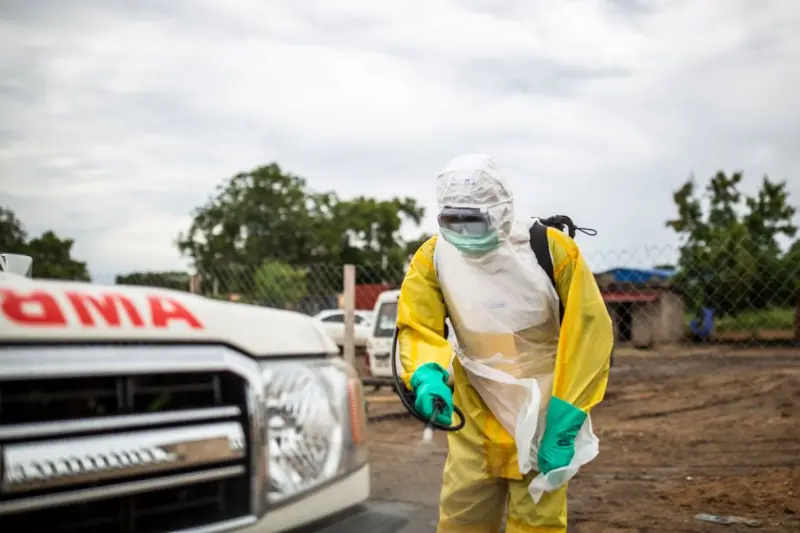
Image source, PATRICK MEINHARDT/AFP via Getty Images
Prevention, the best weapon
Although vaccines and treatments have already been developed against other variants of Ebola, authorities and experts consider that the best remedy is prevention. Therefore they recommend measures such as:
Avoid physical contact with people suspected or confirmed to have the disease.
Do not handle bodies of deceased without adequate protection.
Wash your hands regularly.
In the particular case of the Bundibugyo strain, as there are no approved medications, treatment is based on optimized palliative care: pain control, infection management, hydration and nutrition.
Early care increases the chances of survival, say the WHO and the CDC.
*with information from Sofia Ferreira Santos and James Gallagher

Subscribe here to our new newsletter to receive a selection of our best content of the week every Friday.
And remember that you can receive notifications in our app. Download the latest version and activate them.

