


The interstellar object 3I/ATLAS has captured the attention of the international scientific community. Although it appears to be a common comet, several anomalies detected by astronomers suggest that it could be something completely different.
Astrophysicist Avi Loeb of Harvard University warned about the irregularities of this celestial body and called for interpreting the data with an open mind.
Loeb, who already in 2017 proposed that the ‘Oumuamua’ object could have artificial originonce again called into question the nature of another interstellar visitor.
Seven features that baffle experts
Loeb laid out on his blog the seven main anomalies that distinguish 3I/ATLAS from a typical comet:
- Unusual size: It exceeds 5 kilometers in diameter and has an estimated mass of 33,000 million tons. This figure places him above ‘Oumuamua and 2I/Borisov.
- Atypical luminous trail: The tail was visible months after entering the solar system. Comets usually emit gases much earlier.
- Unusual composition: The spectrum showed more nickel than iron, a proportion common in industrial alloys, not in natural bodies.
- Presence of carbon dioxide: Instead of water, it contains CO₂, something never seen in other comets.
- Negatively polarized light: Indicates a highly reflective or polished surface, strange for a natural object.
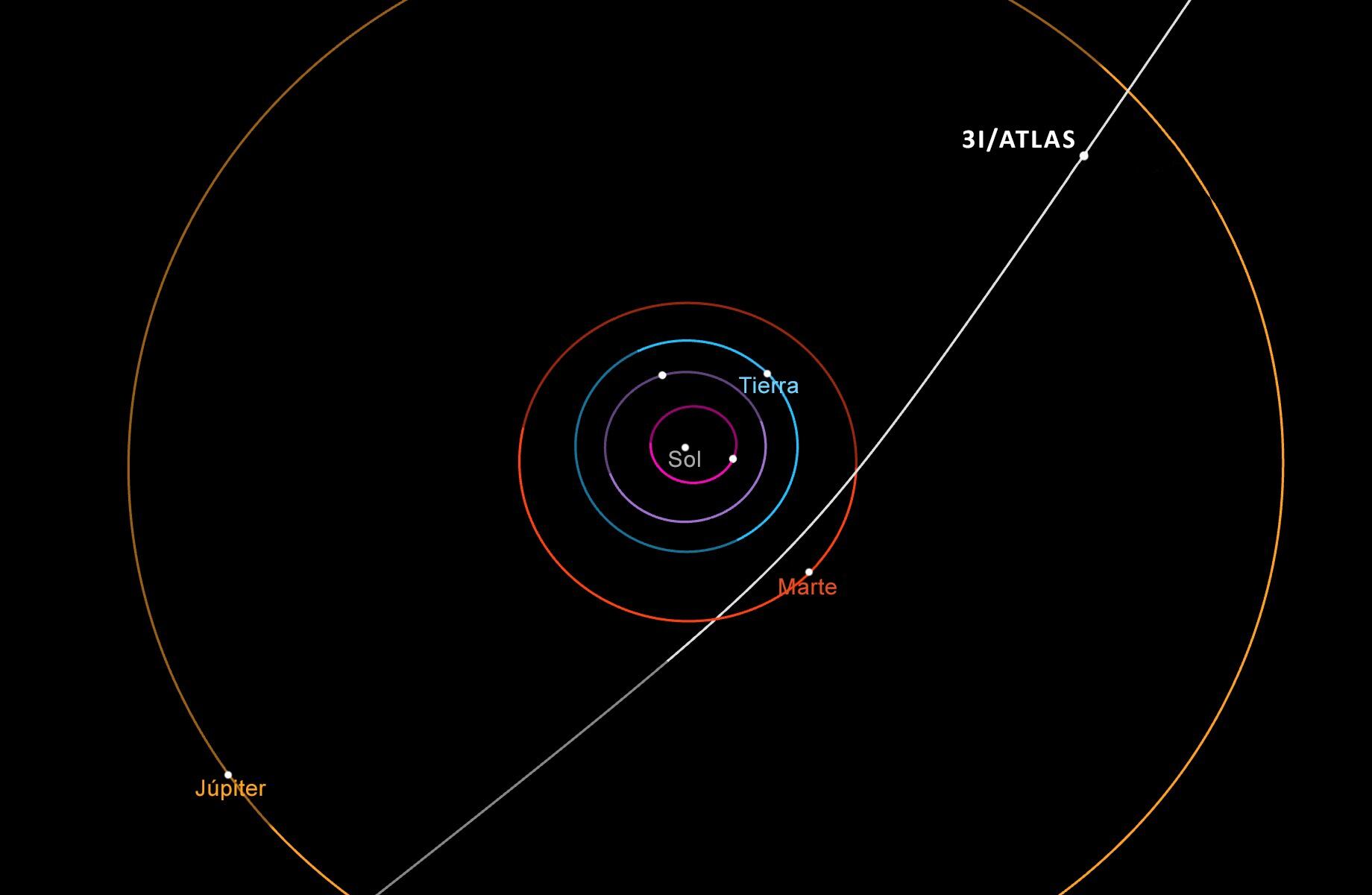
- Perfectly aligned trajectory: Follows the plane of the planets with a precision that, according to Harvard calculations, has a probability of one in a million.
- Close passes to three planets: Your route will take you close to Mars, Venus and Jupiter in no time. Loeb interprets this as a possible deliberate navigation clue. Furthermore, its entry direction coincides with the WOW signal, a radio emission captured in 1977 that some have linked to an extraterrestrial origin.
A visitor from deep space
The 3I/ATLAS comes from interstellar space and is not gravitationally linked to the Sun. It is the third interstellar object identified after ‘Oumuamua and 2I/Borisov.
It traveled towards the solar system at a speed close to 58 km/s (208,800 km/h), making it the fastest known interstellar object. It will reach its closest point to the Sun at the end of October 2025, between orbits of Earth and Mars. Then it will be ejected into deep space, never returning.
Astronomers estimate that this object could have up to 10 billion years old. It would have formed in the early days of the Milky Way, possibly in the thick galactic disk, where the oldest stars are found.
*The creation of this content was assisted by artificial intelligence. The information was researched and selected by a journalist and reviewed by an editor to ensure accuracy. The content was not generated automatically.

