


For the first time in the history of Geology, scientists have witnessed an event that, until now, only existed in books: the dismemberment of one of the Earth’s tectonic plates.
This is not a sudden catastrophe, something imminent … What we should worry about, but about a slow, ancient and progressive death that is occurring just under the Pacific Northwest, off the coast of North America. Like a wounded colossus, a subduction zone, the collision point where one tectonic plate sinks beneath another, is breaking into pieces.
The discovery has just been published in ‘Science Advances’ by a team of geologists led by Brandon Shuck, from Louisiana State University. Thanks to technology capable of doing ‘ultrasounds’ of the planet, researchers have been able to see in ‘real time’ (in geological terms) the deadly cracks that are dismantling the oceanic plate and that, day by day for the next millions of years, will change the geological map of the region forever.
In addition to shedding light on how the Earth’s surface evolves, the research will allow us to refine the seismic risk models of what is one of the most dangerous areas in the world: Cascadia, the place where, at some point, the feared ‘Big One’ will take place.
The tectonic ‘machinery’
As Geology has been discovering in recent decades, the Earth’s mantle is not a static place; It is a kind of ‘ocean’ of molten rock more than 3,000 km deep and on which the tectonic plates that form the Earth’s crust, the thin solid ‘skin’ of our world, float, like immense rock icebergs. And the so-called ‘subduction zones’ are the areas where these floating plates collide, rub against each other or sink beneath each other, thus returning to the depths and ‘recycling’ into new oceanic crust. An unstoppable cycle of death and birth that has been happening for approximately 3 billion years.
It could be said, therefore, that subduction zones are the ‘engines’ of the Earth, the ones that keep the continents moving around the globe, and also the ones that cause the largest volcanic eruptions and the most devastating earthquakes. But if subduction zones continue to generate new crust and also push continents to collide, why haven’t all the oceans already disappeared? The ‘easy’ answer is that they don’t last forever. If they did, the continents would continually collide, pile up on top of each other, and completely erase any record of Earth’s past. But what can stop that ‘machinery’ once it gets going?
Brandon Shuck explains it with a metaphor: “Starting a subduction zone is like trying to push a train uphill: it requires enormous effort. But once it moves, it’s like the train is racing downhill, impossible to stop. Ending it requires something dramatic, basically a train wreck.”
The ‘Cascadia derailment’
Off Vancouver Island, at the northern end of the Cascadia area, scientists have found the answer to that question. There, in effect, the Juan de Fuca and Explorer plates slowly slide (subduct) under the North American Plate, a process that generates monumental seismic stress.
Using information collected in 2021 during the Cascadia Seismic Imaging Experiment (CASIE21), researchers studied the ocean subfloor with ultrasound. From a ship, they sent sonic waves to the ocean floor and then recorded the echoes with a 15-kilometer ‘snake’ of hydrophones, special microphones that capture sounds underwater.
The high-resolution images obtained in this way revealed a shocking reality: the Explorer plate is breaking up. The team, in fact, observed several tears running through the oceanic plate, including a large fault about 75 kilometers long that is actively breaking the entire structure. At a specific point, the detached segment of the plate has already fallen about five kilometers with respect to the neighboring segment. The stress is so great that the process is creating a new tectonic boundary.
In Shuck’s words, “This is the first time we have a clear picture of a subduction zone caught in the act of dying. Instead of shutting down suddenly, the plate is tearing apart piece by piece, creating smaller microplates and new boundaries. “So instead of a big train wreck, it’s like we’re watching a train slowly derail, one car at a time.”
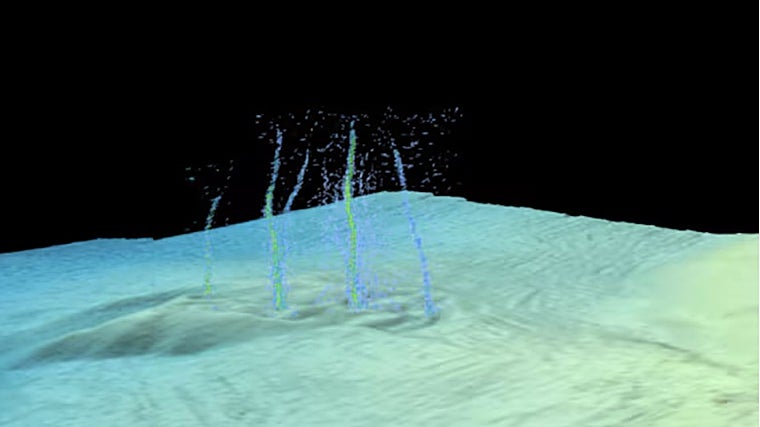
Underwater crack off the coast of Oregon, United States
The mechanism has been called ‘episodic termination’ or ‘piecemeal’. The key to the process lies in the so-called ‘transform boundaries’, the faults where plates slide laterally. These faults act like enormous ‘geological scissors’ that ‘cut’ perpendicular to the subduction zone. And when detached, each fragment of the plate becomes an independent microplate.
According to the study, the clearest evidence that this process is underway is not only the seismic image, but the absence of activity. In fact, along the 75km tear, while some sections are still seismically active (because the rocks are still ‘stuck’), others have fallen into an eerie seismic silence. Shuck and his colleagues believe that this ‘gap’ without seismicity is the unmistakable sign that that piece has completely broken and detached. By losing weight and contact surface, the subducting plate loses the gravitational ‘pull’ that drags it towards the mantle, and the system slowly stops.
The origin of volcanism
The importance of the discovery of this progressive tearing process in Cascadia goes beyond the region itself, as it provides the key to understanding ‘geological mysteries’ that take place in many other places in the world.
For decades, for example, scientists have observed ‘abandoned’ fragments of plates and unusual outbreaks of volcanic activity in numerous regions of the planet. An example is that of the coast of Baja California (Mexico), where what have come to be called ‘fossil microplates’ have been identified. These are the shattered remains of what was once the immense Farallon Plate, which in the past subducted under the western coast of America.
Scientists knew that these fragments were proof that that gigantic subduction zone had ‘died’, but the exact mechanism that had pulverized it into small remains was not clear. The new study in Cascadia has revealed the missing piece: the Farallon Plate did not collapse in a single catastrophic event, but was dismantled step by step, leaving its remains as geological testimony.
The consequences of these progressive tears are profound. As the plate fragments separate, in effect, they create in the subsurface what are known as ‘slab windows’, openings through which extremely hot mantle material can rise to the surface, causing outbreaks of intense volcanic activity.
Something that, again, fits perfectly with the geological record: “It is a progressive breakdown, one episode at a time,” says Shuck. “And it fits very well with what we see in the geological record, where volcanic rocks become younger or older in a sequence that reflects this step-by-step tearing.”
Home of the ‘Big One’
The Cascadia subduction zone is known worldwide for one reason only: it is the potential source of the ‘Big One’, a megaearthquake capable of unleashing an unparalleled catastrophe in the Pacific. This fault system, in fact, with its almost 1,100 kilometers in length, extends from northern California to British Columbia, in Canada. And historical and geological data tell us that the area is capable of generating earthquakes of magnitude greater than 9.0, followed by devastating tsunamis. The last major event of this type occurred on January 26, 1700, and it is estimated that these megaearthquakes repeat themselves, on average, between 300 and 500 years. We are, therefore, in the time window of risk.
Now, does the tear in Cascadia increase the probability of the Big One? Scientists believe not, at least in the short term, on the human time scale. In fact, regardless of the tear, Cascadia remains a region perfectly capable of producing massive earthquakes and tsunamis. But even so, the discovery is of vital importance when developing seismic hazard models. Knowing that the plate is segmenting and breaking up in the north confirms the complexity of the entire subduction zone.
Previous research already suggested that Cascadia was not a single continuous fault, but was divided into at least four segments capable of rupturing both independently and together. Therefore, the new tears and newly identified microplates add layers of complexity to those models. Now, scientists must determine whether a large earthquake could propagate across these newly formed faults or whether, instead, the rupture points and new boundaries could act as shock absorbers, altering the way seismic ruptures propagate across the planet.

