


At what point in life does our brain to form thoughts? In the womb? After we are born, in response to our sensory experiences of the world around us? Or are we born, perhaps, with a ‘preconfigured’ brain in which the ability to … think it already comes ‘as standard’? These are questions that philosophers have been grappling with for centuries. And now, a new study by researchers at the University of California, Santa Cruz, just published in Nature Neuroscience, has come closer than ever to the answer.
Using tiny models of human brain tissue, so-called ‘organoids’, researchers have studied how electrical activity arises in the brain. And they have discovered that the first ‘flashes’ occur in well-structured patterns and do not depend on external experiences. Which suggests that the human brain already incorporates, from origin, specific instructions about how to navigate and interact with the world.
A brain ‘operating system’
“These cells – says biomolecular engineer Tal Sharf, lead author of the study – clearly interact with each other, and form self-assembling circuits before we can experience anything of the outside world. There is a pre-existing ‘operating system’, which emerges in a primordial state. In my lab, we grow brain organoids to look at this primordial version of the brain operating system and study how the brain builds itself before being shaped by sensory experience.«
The brain, like computers, works based on electrical signals, which are what ‘start’ the neurons. But knowing exactly when and how these signals start to activate is very difficult to achieve, since the early development of the human brain is well protected in the womb.
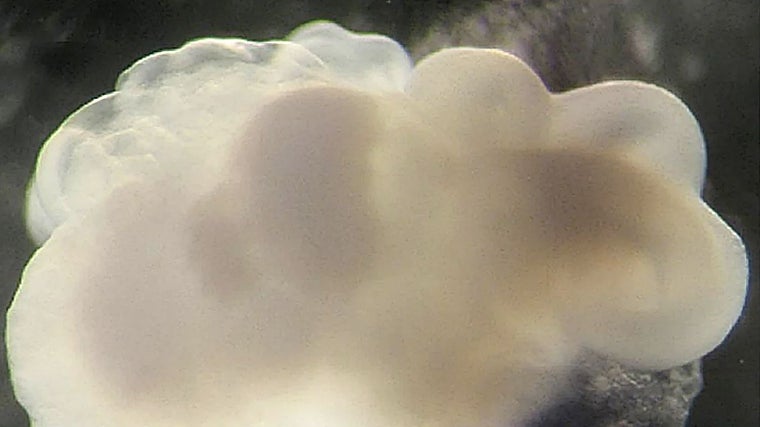
Brain organoid grown from human skin cells
But that is why organoids were created, 3D models of tissue grown from human stem cells in the laboratory and which are used to study, without having to touch them, organs such as the liver, lungs, kidneys, intestine, stomach… or the brain. The University of California, pioneer in organoids brain cells, is developing new methods to grow them and then take measurements of them to gain insights into brain development and disorders.
Before the ‘empire of the senses’
Specifically, organoids have proven to be especially useful in understanding whether the brain develops in response to sensory inputsince they exist in the laboratory environment and not in the body. In their study, Sharf and his colleagues stimulated brain tissue formation from stem cells and then measured their electrical activity using specialized microchips, similar to those that run a computer.
«An organoid system that is intrinsically uncoupled from any sensory input or communication with the organs – explains the researcher – is an open window to what happens with this self-assembly process, something really difficult to do with traditional 2D cell cultures, in which you cannot achieve the necessary cellular diversity or architecture. The cells must be in intimate contact with each other. we are trying control initial conditionsand thus let biology work its miracles.”
The researchers observed the electrical activity of brain tissue as cells self-assembled into tissue capable of ‘translating’ the senses and producing language and conscious thought. In this way, they discovered that in the first months of development, long before the human brain is capable of receiving and processing complex external sensory information such as vision and hearing, Your cells have already spontaneously begun to emit signals. electrical characteristics of the patterns that underlie the ‘translation’ of the senses.
Default mode
Long decades of research in neuroscience have led to the discovery that neurons activate in patterns that are not just random. Instead, the brain has a ‘default mode’, a basic underlying structure for activating neurons that then becomes more specific as the brain processes unique signals, such as a smell or taste. This ‘background’ mode describes the possible range of sensory responses that the body and brain can produce.
In their observations, Sharf and his team found that these early observable patterns bear a striking similarity to the brain’s default mode. Even without having received any sensory input, they activate a complex repertoire of sequences that have the potential to be later refined for specific meanings. Which reveals the existence of a genetically encoded ‘blueprint’ that is inherent to the neuronal architecture of the living brain.
“These intrinsically self-organized systems,” explains Sharf, “could serve as a basis for build a representation of the world that surrounds us. The fact that we can see them in these early stages suggests that evolution has found a way for the central nervous system to build a map that allows us to navigate and interact with the world.”
Knowing that these organoids reproduce the basic structure of the brain opens a series of possibilities for better understand neurodevelopment human, diseases and the effects of toxins on the brain.
«We are demonstrating -concludes the scientist- that there is a basis for capturing complex dynamics that could probably be signals of pathological beginnings that we could study in human tissue. That would allow us to develop therapies, working at a preclinical level to develop potential compounds, drug therapies and gene editing tools that could be cheaper, more efficient and with higher performance than the current ones.”

