


GENERATING AUDIO…
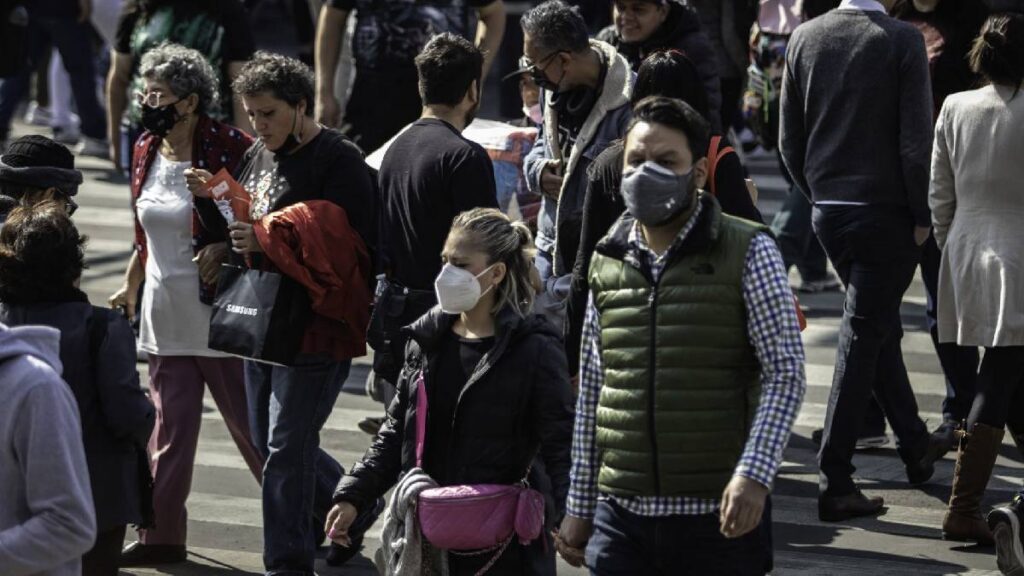
Every December 27, the International Epidemic Preparedness Day It opens a space to look beyond the immediate situation and review a history that has been repeated for centuries. Long before COVID-19humanity had already gone through episodes of illness that crossed continentsaltered entire populations and were recorded fragmentarily in fiscal, parish and archaeological archives.
What were the death tolls from pandemics in history?of Our World in Dataallows us to reconstruct that journey and place the most lethal pandemics in history on the same timeline, based on demographic estimates, mortality records and epidemiological models.
Within the framework of this commemoration, the data offer a long-term look at how epidemics have accompanied the development of societies and how their impact has been measuredinterpreted and documented throughout the centuries.
flu outbreaks, cholera, bubonic plague, smallpox, measles and other diseases have spread at different periods throughout large regions of the world, with far-reaching demographic consequences, as this document documents. historical database.
A timeline of pandemics
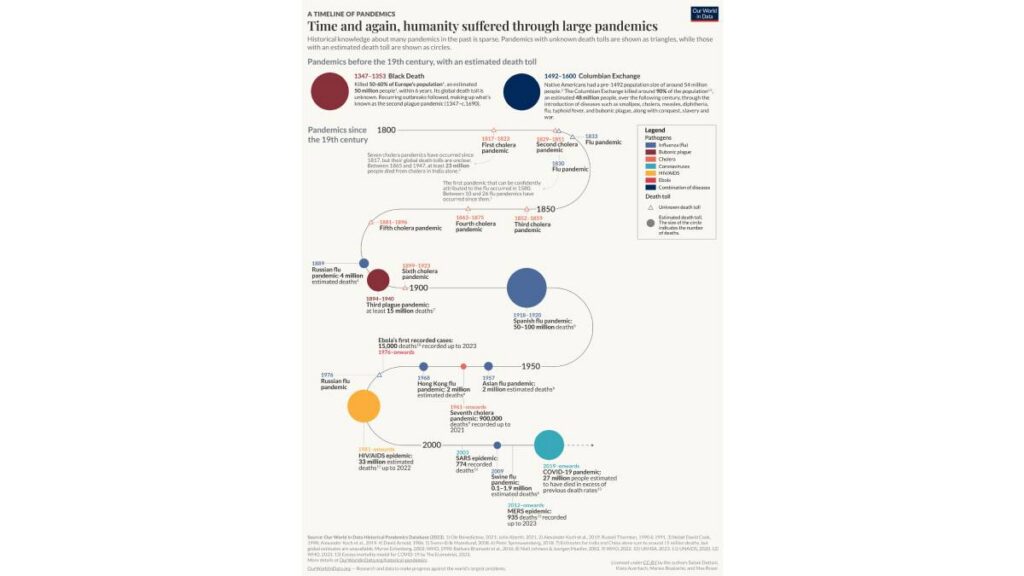
The study of Our World in Data gathers estimates of pandemic deaths throughout history and presents them on a timeline. In this visualization, pandemics with estimated numbers are represented by circles, the size of which indicates the number of deaths, while those without quantifiable data appear without an estimate.
Among the pandemics prior to the 19th century, the the black plague (1347–1353). According to Our World in Datathis event caused the death of between 50 and 60% of the European populationwith an estimated 50 million people in a period of six years. There are records of outbreaks in Western Asia, the Middle East and North Africa, although a complete global figure is not available. After the initial waverecurrent outbreaks were documented until approximately 1690, in what is known as the second plague pandemic.
Another central episode in the chronology is the Columbian Exchange (1492–1600). Our World in Data estimates that the indigenous population of America was about 54 million people before 1492. Over the next century, nearly 48 million died, representing an approximate 90% reduction. This estimate is based on the net reduction in population and considers the introduction of diseases such as smallpoxcholera, measles, diphtheria, influenza, typhoid fever and bubonic plague, as well as processes of conquest, slavery and war.
Pandemics since the 19th century
According to Our World in Datasince 1817 there have been records seven cholera pandemics. Although the total number of deaths worldwide is uncertain, records indicate that between 1865 and 1947 at least 23 million people died from cholera in India alone. Are pandemics mainly originated in the Indian subcontinent and expanded to other countries and continents through trade, travel and armed conflict.
The flu has been another recurring cause of pandemics. The analysis of Our World in Data points out that the first influenza pandemic attributed with certainty occurred in 1580 and that since then between 10 and 26 pandemics have been recorded. The one with the greatest impact was the Spanish flu of 1918–1920, with an estimate of between 50 and 100 million deaths. Other pandemics included in the database are the Russian flu of 1889, with around 4 million deaths; the Asian flu of 1957 and the 1968 Hong Kong fluwith nearly 2 million each; and the 2009 swine flu, with estimates ranging from 100 thousand to 1.9 million deaths.
The third bubonic plague pandemic (1894–1940), documented by Our World in Datamainly affected to Asia and Africa and caused at least 15 million deaths. The disease was caused by bacteria Yersinia pestiswhose transmission mechanism—through rat fleas—was not known in previous pandemics.
Contemporary epidemics and pandemics
In the chronology of Our World in Data recent epidemics also appear. HIV/AIDSidentified in the early 1980s, has caused an estimated 33 million deaths in the world between 1981 and 2022. These figures are obtained using available data and statistical models that consider the transmission of the virus, access to treatment and recorded deaths.
Other events included are SARS in 2003, with 774 recorded deaths; MERS, detected since 2012, with 935 deaths recorded until 2023; and Ebola, whose first cases were documented in 1976 and which has caused at least 15 thousand registered deaths until 2023, according to the database.
The pandemic of COVID-19 occupies one of the last places in the timeline. Our World in Data points out that the impact is mainly measured by Excess mortality due to limitations in testing and in the registration of causes of death in many countries. With this method, it is estimated that around 27 million additional deaths occurred between January 2020 and November 2023.
The study of Our World in Data underlines that the historical understanding of pandemics largely depends on the availability of data. The development of death records, scientific research and statistical models have made it possible to reconstruct the impact of diseases that, at the time, could not be accurately measured.
Follow Uno TV on Google Discover and check the news instantly.
Do you have a complaint or information you want to share? Write to us on Uno TV WhatsApp: +52 55 8056 9131. Your message can make a difference.

