


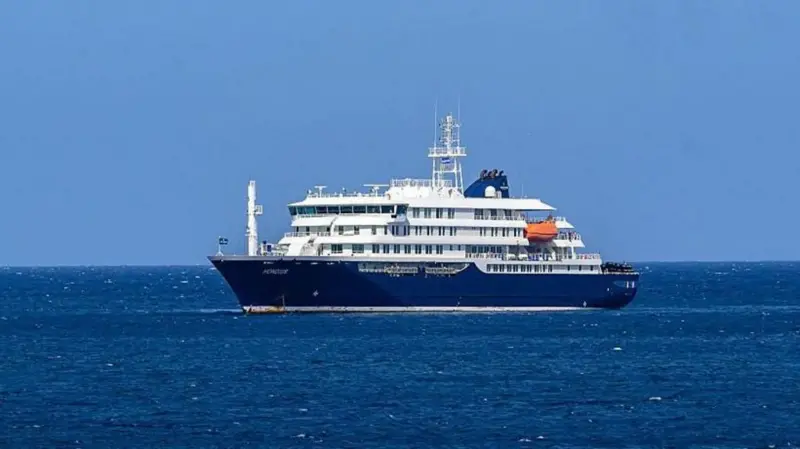
Image source, AFP via Getty Images
-
- Author, Tinshui Yeung
- Author’s title, BBCNews
-
Reading time: 4 min
Three people died after a suspected hantavirus outbreak on a cruise ship sailing in the Atlantic Ocean, according to the World Health Organization (WHO) reported to the BBC.
One case of hantavirus was confirmed and another 5 suspected cases are being investigated, according to the WHO.
The cases were recorded aboard the MV Hondius cruise ship, which was traveling from Argentina to Cape Verde, in Africa.
Hantavirus infections are usually related to environmental exposure, such as contact with the urine or feces of infected rodents, but in rare cases they can be transmitted between people, causing severe respiratory illness.
The UK Foreign Office told the BBC that it is in contact with the cruise company and local authorities.
“We are closely monitoring reports of a possible hantavirus outbreak on the cruise ship Hondius,” he explained.
Foster Mohale, spokesperson for the South African Ministry of Health, had previously told the BBC that at least 2 people had died.
The MV Hondius is managed by the Netherlands-based tour company Oceanwide Expeditions.
According to the itinerary published on the Oceanwide Expeditions website, the MV Hondius set sail from Ushuaia (Argentina) on March 20 and was scheduled to end its voyage on May 4 in Cape Verde.

polar cruise
It is a 107.6 meter long polar cruise ship, with capacity for 170 passengers distributed in 80 cabins, in addition to 57 crew members, 13 guides and a doctor.
As South African authorities informed the BBC, the first person to present symptoms of the virus was a 70-year-old passenger who died on board. His body is now found on the island of Saint Helena, a British territory located in the South Atlantic.
His wife, 69, also fell ill on board and was evacuated to South Africa, where she died in a Johannesburg hospital.
The couple was of Dutch nationality, according to the AFP news agency, citing a source close to the case.
On condition of anonymity, the source told AFP that the third fatality was still on board the ship, and that talks were being held to decide whether two other sick passengers should be placed in isolation in a Cape Verde hospital.
According to reports, the ship would then continue to the Canary Islands, in Spain.
The WHO said it was helping to coordinate between Member States and ship operators the medical evacuation of 2 symptomatic passengers, as well as a full assessment of public health risks and support for those still on board.
Argentina and the hantavirus

Image source, Getty Images
Hantavirus is a serious viral disease transmitted by wild mice and in Argentina it is common for there to be some cases every year. According to the National Epidemiological Bulletin of that country, 32 cases have already been recorded so far in 2026.
The virus is transmitted through the saliva, feces and urine of infected mice, mainly the so-called long-tailed ones. The most common cause of infection is inhalation of dust that leaves urine dry in closed places.
The sun’s rays and disinfectants kill the virus, which is why it is not common for there to be many infected.
But hantavirus can also be transmitted between humans, during the first days of contagion. This is unusual, but it was what Argentine health authorities detected in 2019.
In January of that year, a fatal outbreak was recorded in which 12 people died in the Latin American country.
According to the Mayo Clinic, in the first stage the hantavirus generates flu-like symptoms: fever, muscle aches, chills, headaches, nausea, vomiting, abdominal pain and diarrhea.
But, “as the disease progresses, it can cause damage to lung tissue, fluid buildup in the lungs, and serious problems with lung and heart function,” a condition called hantavirus pulmonary syndrome (HPS).

Subscribe here to our new newsletter to receive a selection of our best content of the week every Friday.
And remember that you can receive notifications in our app. Download the latest version and activate them.

