


Image source, Getty Images
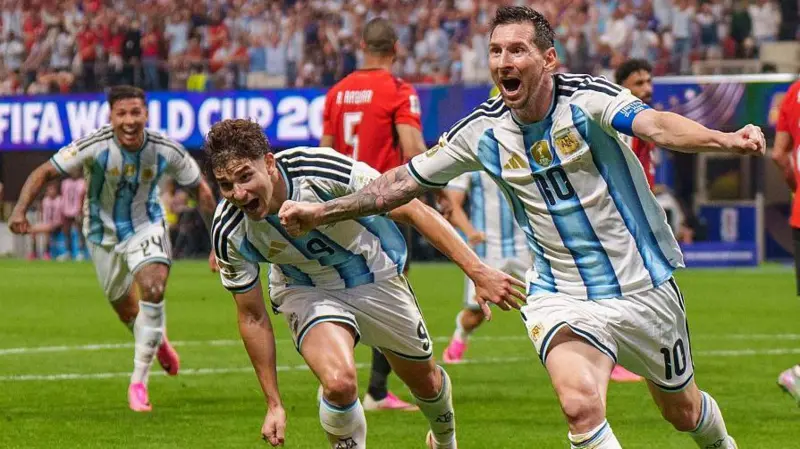
Argentina is leaving everything to defend its world title and it needed to do so.
After the Albiceleste were expected to sweep Cape Verde and Egypt in the first two knockout rounds, they had to fight tooth and nail to claim 3-2 victories in both matches.
But the victory against Egypt had a controversial background, as the African nation asked FIFA to expel from the tournament the referees responsible for their defeat in the round of 16.
Egypt alleged bias in favor of Argentina and favoritism towards its star player, Lionel Messi.
After the match, coach Hossam Hassan stated that Egypt had been “unfairly treated” and had “suffered injustice”.
Hassan then pointed out that FIFA has some kind of bias.
“Maybe they wanted to keep the world champion in the competition. Maybe they wanted Messi to continue in the fight,” he said.
BBC Sport analyzes whether there is any truth to the theory that everything is in place for Argentina to be successful.
Are Egypt’s complaints justified?
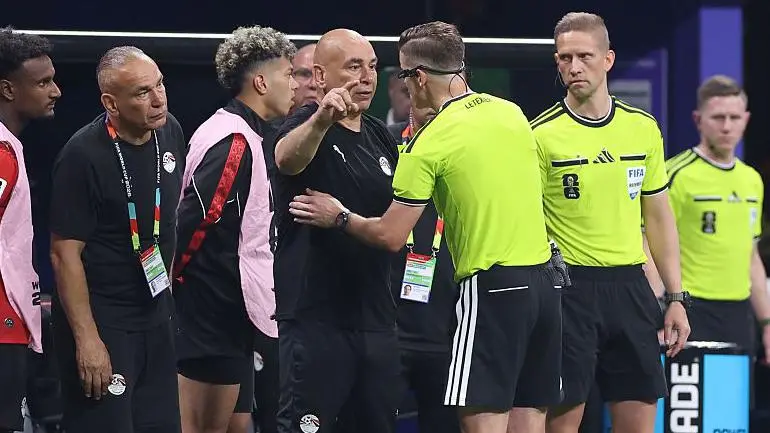
Image source, Getty Images
It’s easy to understand why Egypt is so frustrated after Tuesday’s 3-2 defeat.
The Africans led 0-2 with 11 minutes remaining and were one step away from a historic first appearance in the quarterfinals.
But everything went wrong when Argentina reacted strongly, turned the game around and scored the winning goal in injury time.
Egypt claims there was something more suspicious. They attribute their elimination to “serious refereeing errors” and a “double standard” on the part of French referee François Letexier and his team.
The Pharaohs had a goal disallowed after VAR intervention.
They also claim that Argentina’s third goal should have been disallowed and that, instead, a penalty should have been awarded in their favor.
Mostafa Zico’s brilliant goal was disallowed after Marwan Attia was penalized for stepping on Lisandro Martínez’s foot at the start of the play.
It was a controversial decision, but they were leading 1-0 and scored a second goal nine minutes later. It is impossible to know if the match would have had a different outcome if Zico’s goal had been valid.
Egypt believe there were two potential penalties in their favor before Enzo Fernandez headed in the winning goal.
Hamdi Fathy fell to the ground and said that Alexis Mac Allister grabbed him, something that was not clear in the replays, while Mohamed Salah felt that Julián Álvarez tripped him, although the Argentine striker had won the ball from him and the contact was minimal.
There are some similarities between the situations of Martínez and Salah, with foot-to-foot contact, but not enough for the referee to sanction the play with a penalty.
Egypt would have had a better chance of having their goal disallowed if Salah had been outside the area. The VAR would have simply judged a foul, as happened with Martínez, instead of having to charge a penalty.
Controversial? Maybe. But it hardly constitutes proof of a conspiracy in favor of Messi.
France will face a full team of Argentine referees
Check out Thursday’s quarterfinal matches between France and Morocco.
For the first time in this World Cup, the entire refereeing team on the field of play – head judge, two assistants, fourth referee and substitute – comes from the same country.
And that country is Argentina.
On the other two occasions in which the Argentine Facundo Tello was appointed to administer justice in this World Cup, the fourth referee and the substitute were first from Saudi Arabia and then from Colombia.
The argument of those who see a conspiracy is that Argentina wants France to be eliminated. After all, both are favorites in the Cup.
France-Morocco is one of the most important matches of Tello’s career, his second consecutive quarterfinal match in the World Cup.
A referee of such a high level is not going to act without the utmost integrity.
But perception is often just as important, and naming Argentine referees for the match against France in the quarter-finals raises questions.
However, it is worth remembering that the referee of the match between Argentina and Egypt was precisely a Frenchman: François Letexier.
Messi avoids the red card and scores five goals
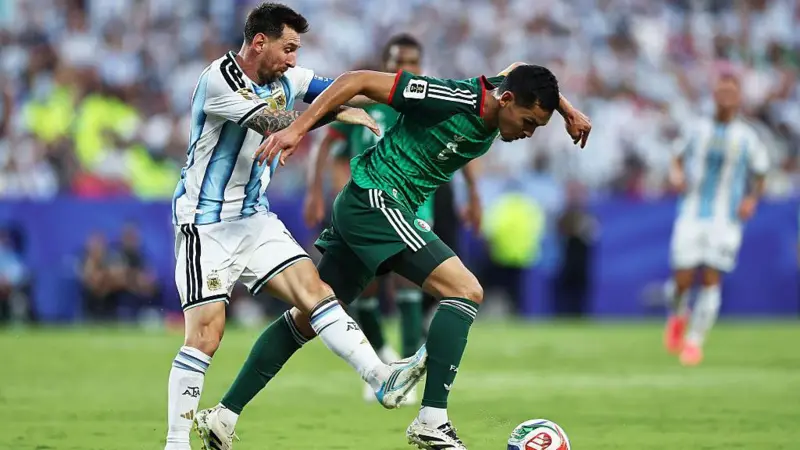
Image source, Getty Images
Remember the start of the tournament and the possible red card for Messi.
Messi did not even receive a yellow card for his play on Algeria captain Aïssa Mandi.
Last week one of the most notorious incidents of this World Cup took place.
American Folarin Balogun was sent off following a VAR review against Bosnia in similar circumstances. Both attacked the opponent’s calf.
The United States may have emphasized this point when it fought for the ban on Balogun to be lifted.
If Messi had been sent off, he would not have scored his two goals against Algeria, nor the double against Austria, as he would have been sanctioned, unless FIFA decided to apply article 27, as it did with Balogun.
Messi would also not have been available for the final group stage match against Jordan, in which he scored again.
That takes away five of the eight goals he has scored in the tournament.
Was this special treatment for Messi?
How Infantino “made sure” in the past that Messi plays
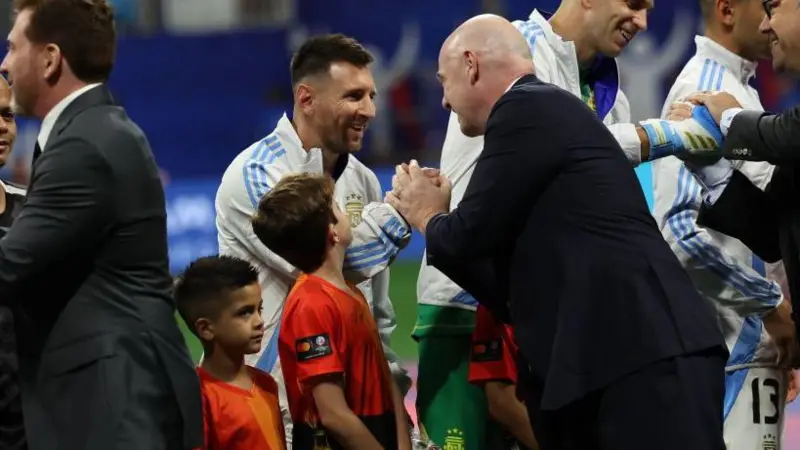
Image source, Getty Images
FIFA president Gianni Infantino seems to like having Messi in his tournaments.
Take for example the first Club World Cup that was held last year in the US.
There was a slight delay before it was confirmed which team from the host country would participate.
Wouldn’t they be the champions of 2025? After all, this is a tournament for the best teams, based on defined merits.
Inter Miami won the Supporters’ Shield (Fans Shield) of the American Soccer League (MLS) in 2024. That recognition is awarded to the team with the most points.
But it was the LA Galaxy that was finally crowned champion, winning in the playoffs.
However, Inter Miami was selected for the Club World Cup.
This allowed Messi to play in the opening match, at the Hard Rock stadium in Miami, against Al Ahly.
Does the World Cup draw favor Argentina?
FIFA introduced a small but significant change to the World Cup draw in December.
The top four countries in the FIFA world rankings (France, Argentina, Spain and England) were drawn into separate quadrants.
If those countries finished first in their respective groups, as they did, they could not meet until the semifinals.
France and Spain are in one half of the draw and are heading to meet in the semi-finals, while Argentina and England are in the other half.
The idea is to limit the possibility of stellar matches occurring early in the tournament.
But depending on how the groups stack up, it also offers those countries a more favorable path forward.
In the first two knockout rounds, there were only two matchups between the world’s top 10: Netherlands against Morocco and Spain against Portugal.
Argentina seems to have had the easier path, even though they only beat Cape Verde (67th in the world) and Egypt (29th) 3-2.
The next opponent in the quarterfinals is Switzerland (19th).
England will not face any of the top ten unless they face Argentina in the possible semi-final. Yes, they had to beat Mexico (14th) at the Azteca Stadium.
Spain has beaten Portugal (5th) and now faces Belgium (9th), while France faces Morocco (7th) in the quarterfinals.
Argentina has had the best part in this sense, although it must be taken into account that the Albiceleste is not responsible for Portugal not finishing first in its group in the first phase or for Colombia being eliminated by Switzerland in the round of 16.
Are the referees showing fewer yellow cards to Argentina?
The quarterfinals carry a risk. Seventeen players are one yellow card away from being excluded from a possible semi-final.
Argentina is not in as much danger, as only Gonzalo Montiel is at risk of missing the semi-final against England or Norway.
England manager Thomas Tuchel has four players booked, including key players Jude Bellingham and Declan Rice.
Norway, which is the country with the fewest yellow cards, only has Antonio Nusa cautioned.
To evaluate this, it is necessary to take into account how “dirty” the team’s play has been. Does the number of yellow cards match the number of fouls?
Argentina has received a yellow card every 19.7 fouls.
Only three teams – Czech Republic (37.0), Norway (24.0) and Tunisia (27.0) – have a higher proportion of yellow cards for fouls.
Of the teams still in the race, England have received the harshest treatment, with a yellow card every 7.7 fouls.
Argentina has committed more fouls than England, but has received half as many yellow cards.
This could suggest that Argentina receives more favorable treatment compared to the number of fouls it commits, although the number itself is not enough to draw conclusions, since the fouls They may be more or less severe and, therefore, may or may not merit warnings.
More penalties for Argentina
When Argentina won the World Cup in 2022, they set a new record in the process.
The five penalties called in their favor were the most for a team in a single tournament.
In 2026, they once again lead the table with three penalties, although Messi has missed two of them, against Austria and Egypt.
England and Switzerland have benefited from two, while Belgium, France and Norway have received one each.
However, some sports commentators have said that, from a statistical point of view, it is also likely that Argentina was awarded more penalties because it is a team that favors attack and possession of the ball.
This article was originally written in English and we used an artificial intelligence tool to translate it. BBC journalists reviewed the text before publication. Learn more about how we use AI.

Subscribe here to our new newsletter to receive a selection of our best content of the week every Friday.
And remember that you can receive notifications in our app. Download the latest version and activate them.

