


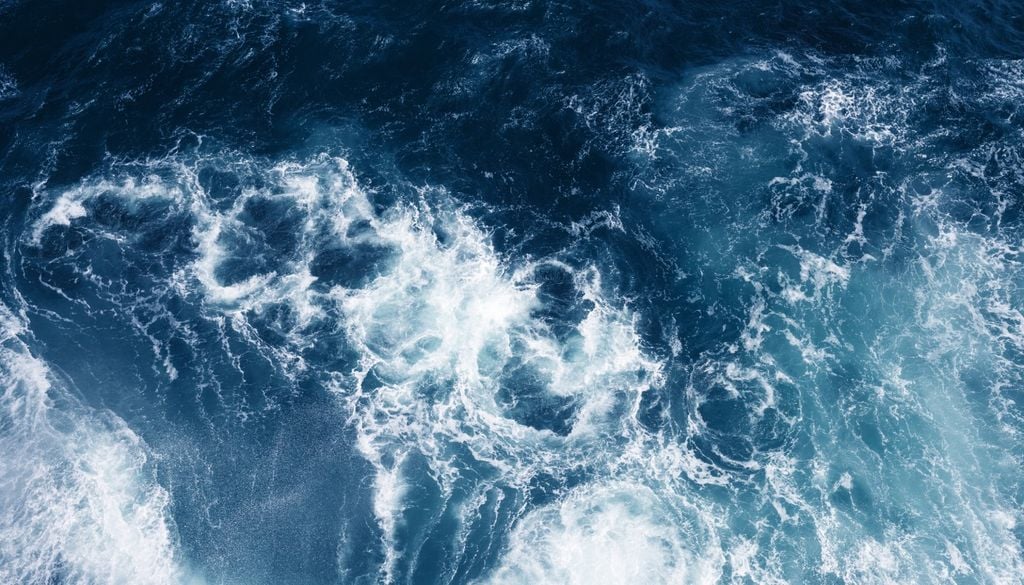
Turbulence in the deep ocean is a process that distributes heat, nutrients and carbon from the surface to the seabed and vice versa. However, the tools used to predict its effects do not adequately represent this turbulence.
Climate models and the ocean
The researchers identified several rapidly evolving climate processes affected by small-scale turbulence, including the distribution of heat, nutrients and carbon. There is a need to significantly improve the way models predict how turbulence in the deep ocean will affect life on land.
“There is ocean microphysics, similar to cloud physics, that is extremely difficult and expensive to observe, but that governs our lives on human-relevant time scales: from changes in ocean circulation and ecosystem dynamics, with implications for fisheries and food security, to coastal flooding and heat waves.”
“We need the tools we use to predict these effects to be as accurate as possible, and we have found that this is not currently the case,” says lead author Dr. Laura Cimoli, from the Department of Applied Mathematics and Theoretical Physics (DAMTP) at the University of Cambridge.
The team evaluated the accuracy of climate models using CFC (chlorofluorocarbon) concentrations. Researchers tracked the distance and speed at which CFCs moved over the past 60 years, measuring your concentration and depth.
Some deep water masses carried CFCs from Antarctica to the central Pacific and the northern Indian Ocean in just four decades. During their journey, CFCs also mix with other bodies of water. Turbulence is the key factor that determines how much tracers, heat and carbon is trapped in the deep ocean and for how long.
Another test involved injecting dye into the deep ocean, at known locations and depths, to track its movement. In the Rockall Trench near the United Kingdom, the dye rose up to 100 meters a day, a speed about 10,000 times faster than predicted by models.
Ocean turbulence
Model results often differed considerably from observational data. The co-author, professor Colm Cille Caulfield of DAMTP, says: “This shows that climate models do not reliably capture the key effects of turbulence in the deep ocean.”
“To make these models more useful to decision makers, we need to better understand the underlying fundamental physical processes, develop better approximations that capture all of these processes in a computationally efficient way, and that can be easily integrated into climate models, and validate and constrain the results of these approximations using many more observational data. All aspects of this process are now threatened due to cuts in scientific budgets.”
Global ocean research of this kind is at risk. In May, the US National Science Foundation announced the dismantling of the Ocean Observatories Initiative (Ocean Observatories Initiative), a $368 million ocean observation network that provides essential oceanographic data around the planetalthough this decision was recently revoked.
Changes in turbulence patterns are affecting the climate, making ocean monitoring imperative. If nutrients do not rise from the ocean depths to the surface, Marine food chains break, causing fisheries to collapse. The way heat is transferred from deep to shallow waters and vice versa influences the melting of Arctic and Antarctic ice, affecting sea level rise, storm intensity and flood levels.
“The deep ocean can interact with the atmosphere on short time scales, and we need reliable tools to help us measure this interaction,” says co-author, Professor Alberto Naveira Farabatofrom the University of Southampton.
News reference
Laura Cimoli et al.. Climatic reach of small-scale turbulence in the interior ocean.

