


In the beautiful movie In the Sultan’s bedroom (Javier Rebollo2024), the characters, playing at making films at a time when cinema was still being born, asked themselves: do images have soul? And they launched into empirical verification the only way they knew how: with a camera, a projector and celluloid. Well, here we are, a century and a quarter after those pioneers, still trying to answer the same question, although common sense tells us that the answer must necessarily be affirmative. The latest investigation in this regard comes from the hand of Guillermo del Torowho understands a lot about souls and images.
An adaptation, we should know by now, is not necessarily better because it is more faithful to its source material. Not worse either. There have been plenty of examples of bad faithful films and excellent literary betrayals. But this one came from Venice Frankenstein (and Donosti and Sitges) with the rumor that it was one of the closest translations of the novel by Mary Shelley. And, finally, nothing could be further from the truth: Guillermo del Toro takes some liberties that would make people pale. James Whale. But it is right there, in his infidelity, where his alchemical spell lies.
Next to Dracula of Bram StokerShelley’s novel is one of the works of fantasy literature that has been brought to the screen on the most occasions. And, as happened with the vampire, movies have rarely captured the plot and even the spirit of the book in a reliable way. In the case of FrankensteinFurthermore, the enormous iconic force that the Universal version of 1931 achieved, with that Boris Karloff with a flat head and little intelligence, he has eclipsed to this day the tragic and eloquent creature dreamed of by Shelley during a distant night of storm and ghost stories in Villa Diodati. Not even the Hammer achieved what it had achieved with its Draculaplacing Christopher Lee at the height of Bela Lugosi in the pantheon of film monsters. The (monster of) Frankenstein Karloff’s work has remained intact to this day in the popular imagination and, in that sense, Del Toro does restore to his creature certain key elements of the novel: fundamentally, his intelligence and sensitivity. But the film is not enslaved to the original, and if what they want are faithful adaptations, there are a handful that are much more so than this one, on television and film: from the television film written by the legendary Daniel Curtis in 1973 to the one produced by Hallmark (yes, the one with the Christmas TV movies) in 2004, passing through the not inconsiderable proposal of Kenneth Branagh of 1994.
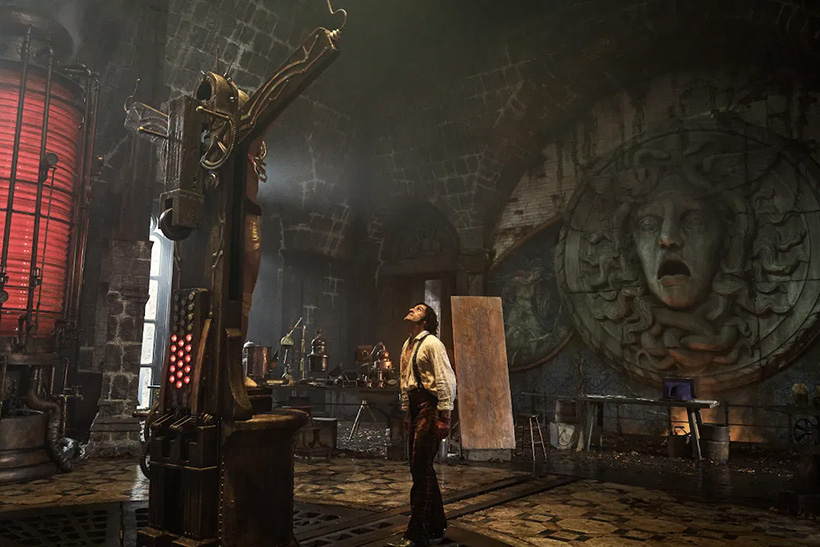
The beauty of Del Toro’s operation lies in how he combines and sutures elements of many previous versions without completely marrying any of them: the narrative template is Shelley’s, yes, but he invents and rewrites characters, situations and places. Elizabeth and William have little to do with the originals, and the Victor Frankenstein played by Oscar Isaac reminds at times the — much more villainous — of Peter Cushing in the Hammer releases, and even takes from him the noble title that he never had in the novel. If, on paper, Victor walked the fine line between obsession and madness, here he clearly abandons himself to the delirium caused by his arrogance. The secluded tower where he carries out his experiments, on the other hand, owes a lot to the Universal; the storm, the life-giving lightning, are elements that do not appear in the book, since the doctor (and not the baron) refuses to give details to his interlocutor to preserve the secret of his feat. And other elements, both visual (the long coat the creature wears) and narrative (the captain’s reconsideration after hearing Victor’s story, when in the novel he only gave in to the insistence of his crew) seem to refer to Branagh. Even the appearance with which the monster appears for the first time has something of that original version from 1910 directed by J. Searle Dawley for the company edison.
So it is a movie.Frankenstein in itself: a work of patchwork that synthesizes the myth from preceding bodies. And here emerges the most beautiful conclusion of the film. After all, it could be said that this work of compilation and recombination is not so different from what current – and misnamed – artificial intelligences do. There are many apostles of “generative” technologies who argue that every artistic work is built on the artist’s background, learning and experience with previous works. So where is the difference between this movie (or any other) and a work regurgitated by AI? The answer is in that brilliance that illuminates the creature’s gaze—proud, tormented, tragic. Jacob Elordi—, a flash similar to the one that nests in the eyes of the replicants of blade runner: this new being, conceived from the remains of others, despite everything has a soul. A soul of its own, fiercely human, that keeps it alive and unique. This Frankensteinin the same way, draws on foreign flesh to build a purely Deltorian film: coherent with the poetics of its author in a way that none of those previous materials could have been on their own. The seams of the film add beautiful and painful parallels, such as the one drawn between Victor and his father: two parents incapable of being one, lacking in their arrogance the empathy necessary to educate their children. And, as in The shape of waterDel Toro appears determined to restore the voice of the monster: here he does so through a diptych structure that gives the creature the role of narrator of its own story, something that in the novel only occurred fleetingly and always keeping its creator as an intermediary. Elizabeth (Mia Goth), becoming the protagonist’s future sister-in-law, shows much more agency than the original, who was intended to be solely Victor’s love object. This time it takes the form of that necessary mirror—the film is a constant game of mirrors—in which, in Guillermo del Toro’s cinema, the monsters look at themselves and see themselves with the beauty that the world denies them. And the creature itself is, ultimately, the essence of its author’s cinema: a dead, beautiful and good figure, defined as a monster by others, and not by its essence.
Frankenstein It achieves, therefore, what any work generated by artificial intelligence can never achieve, even if both are built on foreign fragments: being more, much more, than the sum of its parts. Because images, undoubtedly, have soul, but only when behind them there is a creator in charge of breathing life into them.

