


Image source, Getty Images
-
- Author, Philippa Roxby
- Author’s title, Health Reporter, BBC News
-
Experts from several countries warned that it is necessary to act now to reduce ultra-processed foods in diets around the world due to the threat they pose to health.
In a global investigation, they stated that the way we eat is changing, moving from fresh, whole foods to cheap, highly processed foods, which increases the risk of suffering from a series of chronic diseases, such as obesity and depression.
In an article published in the scientific journal The Lancetresearchers say governments must “step up” and introduce warnings and higher taxes on ultra-processed products, to help fund access to more nutritious foods.
However, some scientists claim that this study cannot prove that ultraprocessed products directly cause health damage and that more research and trials are needed to prove this.
Such foods are defined as those containing more than five ingredients not found in a home kitchen pantry, such as emulsifiers, preservatives, additives, colorings and sweeteners.
Some examples of ultra-processed foods are sausages, chips, pastries, cookies, instant soups, soft drinks, ice cream, and supermarket bread.

Image source, Getty Images
Harmful excesses
Surveys indicate that these industrially manufactured foods are increasing in diets around the world, worsening the quality of what we eat, with an excess of sugar and unhealthy fats and a lack of fiber and protein.
This review of the evidence on the health impact of ultra-processed foods, conducted by 43 global experts and based on 104 long-term studies, suggests that these foods are linked to an increased risk of 12 health conditions.
These include type 2 diabetes, cardiovascular disease, kidney disease, depression, and premature death from any cause.
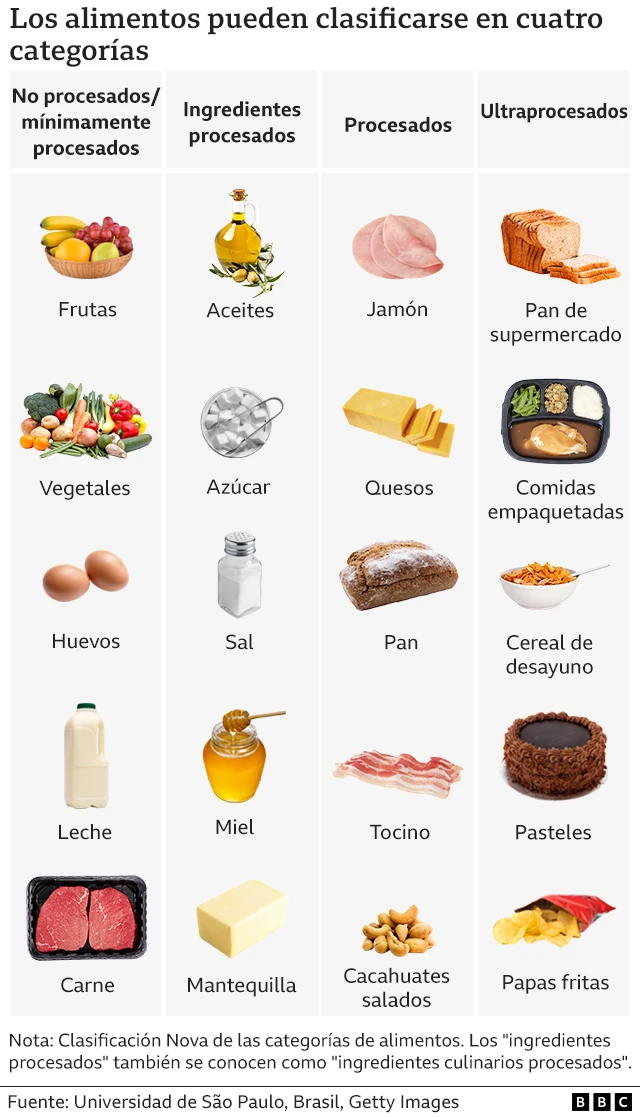
The review’s author, Professor Carlos Monteiro of the University of Sao Paulo, Brazil, who created the Nova classification system to categorize foods, said the growing consumption of ultra-processed foods “is transforming diets around the world, displacing fresh, minimally processed foods and meals.”
“This change in people’s diets is driven by powerful global corporations that generate enormous profits by prioritizing ultra-processed products, supported by a widespread advertising and political pressure campaign to stop effective public health policies that promote healthy eating,” he added.
Research co-author Phillip Baker of the University of Sydney, Australia, said there needed to be “a strong global public health response, including coordinated efforts to challenge the tobacco industry.”

Image source, Getty Images
More research is required
The review acknowledges the lack of clinical trials showing exactly how ultra-processed foods harm health, but says this should not delay measures to protect people around the world from potential health harms.
Some scientists have commented that it is difficult to separate the effects of these foods on people’s diet from other factors, such as lifestyle, behavior and wealth.
Critics of the Nova grading system say it relies too much on the level of processing of foods and not their nutritional value.
For example, whole wheat bread, breakfast cereals, low-fat yogurts, baby formula, and fish fingers are considered ultra-processed, but they have many beneficial properties.
Professor Kevin McConway, emeritus professor of applied statistics at the Open University, said: “A study like this can find a correlation, but it cannot determine cause and effect with certainty.”
McConway said there is still “room for doubt and for clarification with further research.”
“It seems likely to me that at least some ultra-processed foods may increase the risk of some chronic diseases. But this certainly does not establish that all ultra-processed foods increase the risk of disease.”
It is still unclear what it is about these foods that can cause or contribute to illness.

Image source, Getty Images
Professor Jules Griffin, from the University of Aberdeen, Scotland, said food processing has some positive aspects and more research is “urgently needed” to understand how it influences our health.
The Food and Drink Federation (FDF), which represents the industry, states that ultra-processed foods can be part of a balanced diet, such as frozen peas and whole wheat bread.
“Companies have made a number of changes over many years to make the food and drink we buy healthier, in line with government guidance,” says Kate Halliwell, chief scientific officer at the FDF.
The amount of sugar and salt in products sold in stores and supermarkets has been reduced by a third since 2015, he said.
In the UK, the Scientific Advisory Committee on Nutrition said earlier this year that the link between increased consumption of ultra-processed foods and adverse health effects was “concerning”.
However, he added that it is “unclear” whether these foods are unhealthy because of their processing or because many of them are high in calories, saturated fat, salt and free sugars.
The advice on nutrition is to eat more fruits, vegetables and fiber, and reduce the consumption of sugar, fats and salt.

Subscribe here to our new newsletter to receive a selection of our best content of the week every Friday.
And remember that you can receive notifications in our app. Download the latest version and activate them.

