

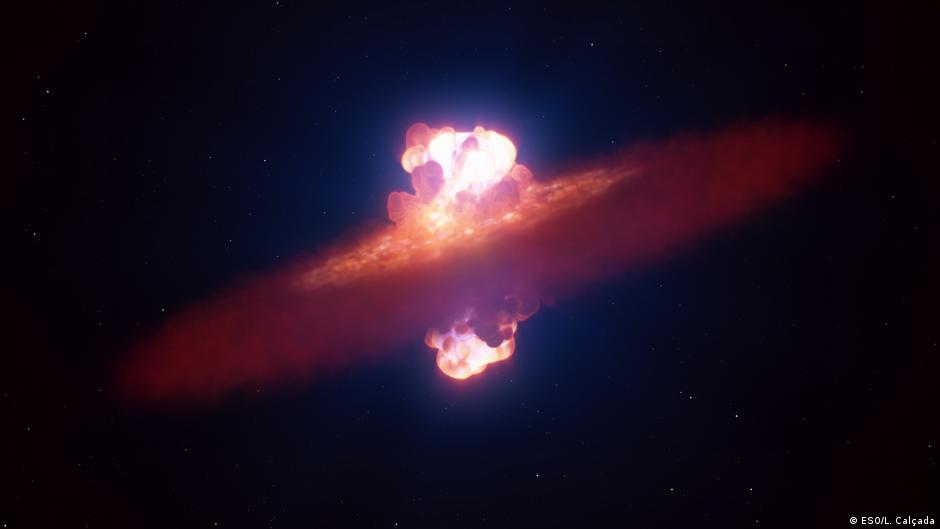
A telescope from the European Southern Observatory (ESO) has captured for the first time the earliest and most fleeting stage of the explosive death of a star, just one day after the phenomenon was detected, a team of astronomers has revealed.
As reported by the institution based in Garching (Germany), thanks to the Very Large Telescope (VLT, in English) it was possible to observe the initial phase of the explosion of the supernova SN 2024ggi, which a day later would no longer have been able to be seen.
A record observation in just 26 hours
The explosion was first detected on the night of April 10, 2024 and immediately the assistant professor at Tsinghua University in Beijing, Yi Yang, sent an observation proposal to the ESO.
It focused its VLT telescope on Chile just 26 hours after the supernova explosion was initially recorded, located in the galaxy NGC 3621, 22 million light years from Earth.
Dietrich Bade, ESO astronomer and co-author of the study published in Science Advances, He explained that for hours the geometry of the star and its explosion could be observed at the same time.
The VLT thus captured the phase in which “the matter that had been accelerated by the explosion near the center of the star was shot across the surface of the star.”
Keys to the physics of supernovae
For his part, Yang noted that the exact mechanisms behind supernovae of massive stars – those that have more than eight times the mass of the Sun – are still the subject of debate.
“The geometry of a supernova explosion provides fundamental information about stellar evolution and the physical processes that lead to these cosmic fireworks,” said the astronomer.
The red supergiant behind SN 2024ggi
The phenomenon observed in this case was a classic example of a massive stellar explosion, since SN 2024ggi had originated from a red supergiant star, with a mass between 12 and 15 times greater than that of the Sun and a radius 500 times greater.
Its first phase could be observed thanks to a technique called spectropolarimetry, which allowed us to obtain clues about the geometry of the exploding star, despite the fact that it appeared as a single point, thanks to the polarization of its light.
Astronomers were thus able to determine that at first the explosion was olive-shaped, but as it spread outward it flattened, however maintaining the axis of symmetry.
“These findings suggest a common physical mechanism driving the explosion of many massive stars, which manifests well-defined axial symmetry and acts at large scales,” Yang explained.
This allows us to discard some of the supernova models that were currently proposed and add new information to others, expanding existing knowledge about stellar explosions, highlighted the ESO.
FEW (EFE, ESO, Science Advances)

