


On August 2, 2027, an astronomical phenomenon unprecedented in the 21st century will occur: a total solar eclipse whose totality phase will last for 6 minutes and 22 seconds, the longest recorded time on land this century.
The National Aeronautics and Space Administration (NASA) confirmed the date of the event through its official site. This eclipse, called he eclipse of the century, It will be partially visible in much of Europe, Africa and South Asia.
However, the total phase – when the Moon completely covers the Sun – can only be observed within a narrow band that It will cross ten countries in the Eastern Hemisphere.
A shadow of more than 15,000 kilometers
According to the specialized portal Eclipse Wisethe zone of totality of the eclipse will include Spain, Morocco, Algeria, Tunisia, Libya, Egypt, Sudan, Saudi Arabia, Yemen and Somalia.
This strip will reach an approximate width of 258 kilometers and will travel more than 15,227 kilometers along the Earth’s surface. In total, the shadow will cover an area of about 2.5 million square kilometers.
Although that number may seem large, it represents only a fraction of the planet: 0.5% of the 510 million square kilometers of the Earth’s surface.
The extraordinary duration of the eclipse is due to the fact that The Moon will be at its closest point to the Earth, known as perigee. This proximity will allow for more extensive and prolonged solar coverage.
In comparison, the total solar eclipse of April 8, 2024, visible in Mexico, the United States and Canada, had a maximum duration of 4 minutes and 28 seconds.
A fleeting twilight, not a complete night
Misinformation has circulated on social media suggesting that “The Earth will be in total darkness for six minutes” and that will not be repeated in 100 years. However, that statement is incorrect. The specialized medium Space.com He explained that there will be no global blackout. In reality, it is an eclipse whose duration will be unusual, but it can only be experienced in the strip of totality.
The site also points out that the dimming perceived during the total phase It is not equivalent to one night, but to a phenomenon similar to a 360-degree twilight.
The light dims briefly and the environment takes on a tone similar to that of sunsetbut the effect is limited to the area where the Moon’s shadow is cast.
The duration and extent of the 2027 eclipse make it a unique opportunity for scientific observation and for astronomical tourism. Some of the highlights within the strip of totality include the city of Tarifa in southern Spain, the coasts of Tunisia, and the city of Luxor in Egypt.
This is how the last total solar eclipse was seen in Costa Rica, in 1991
This is how Costa Rica experienced the last total solar eclipse in 1991
He July 11, 1991 It was marked in the collective memory of Costa Rica as a day when wonder and science met under a transformed sky.
At 2:01 p.m.the Sun disappeared for almost seven minutesplunging the country into a brief “night” in broad daylight.

The country had a privileged position to observe the eclipse in all its magnitude. The lunar shadow entered Coco Beachescrossed Guanacaste cities such as Philadelphia and Nativity scenecrossed the Gulf of Nicoya and continued along the Pacific coast, reaching Parrita, Quepos, Puerto Cortés and Golfito.
The weather conditions were optimal, allowing a clear view of the phenomenon.
Why do solar eclipses occur?

According to the official NASA site, a solar eclipse begins with an almost perfect alignment between the Sun, Moon and Earth: When the Moon comes between the Sun and our planet, it casts its shadow on the Earth and, for a short time, partially or completely blocks the Sun’s light.
This cosmic dance does not occur every new moon, since the Moon’s orbit is inclined by about five degrees with respect to the plane of the Earth’s orbit, which causes the shadow of the satellite almost always passes above or below the Sun from our perspective.
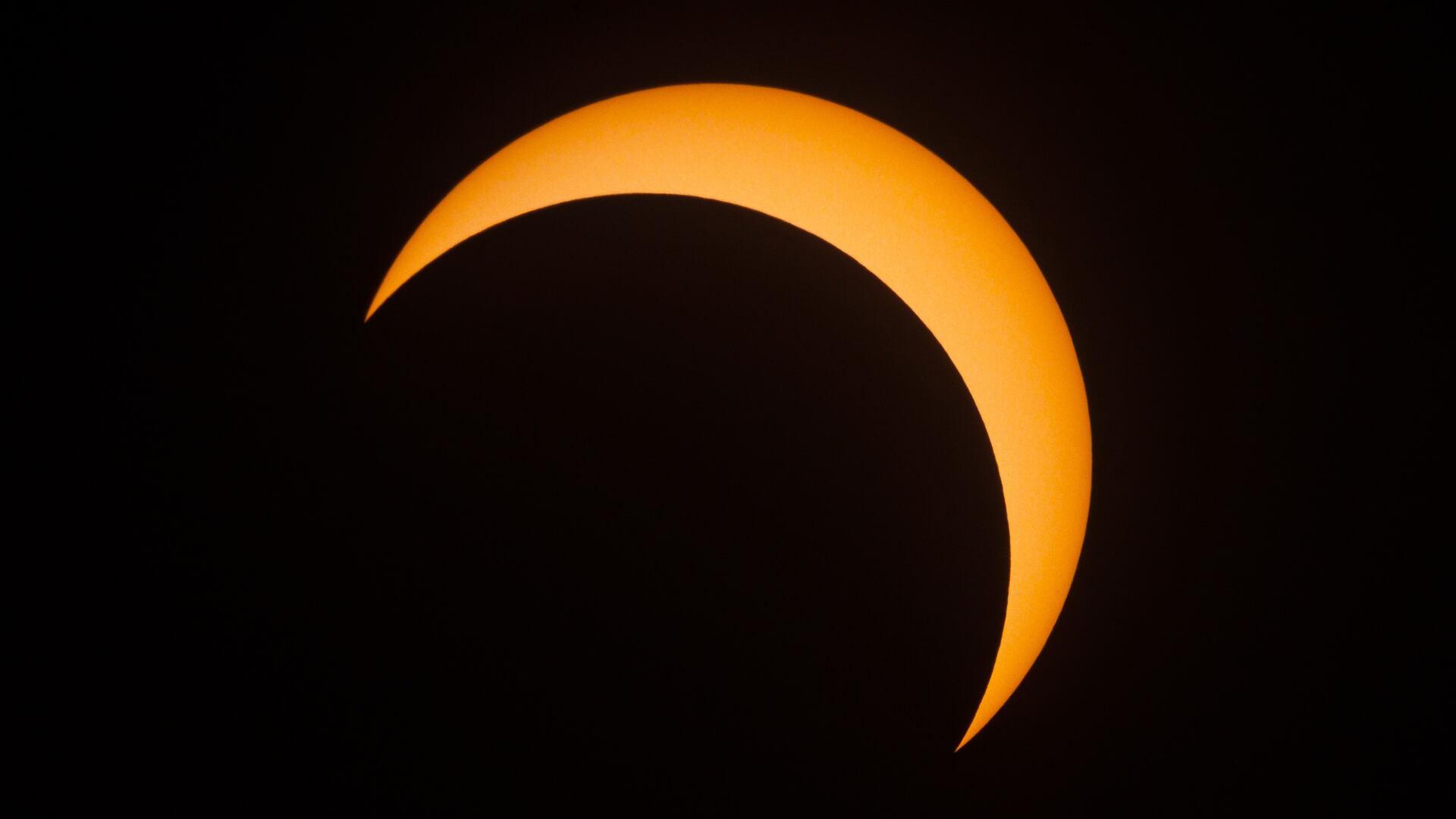
There are several types of solar eclipse, and each one depends on the degree of coverage of the Sun by the Moon. In a total eclipsethe Moon completely blocks the solar disk from certain places on Earth and for a few minutes you can contemplate the pale corona of the Sun, normally hidden by the glow of its surface.
In a annular eclipsethe Moon is a little further from the Earth and does not completely cover the Sun, leaving a luminous ring around the lunar disk.
In the partial eclipsesonly part of the Sun is covered, since the alignment is not perfect, and finally the hybrids They can behave as total or null depending on the place from which they are observed.

