


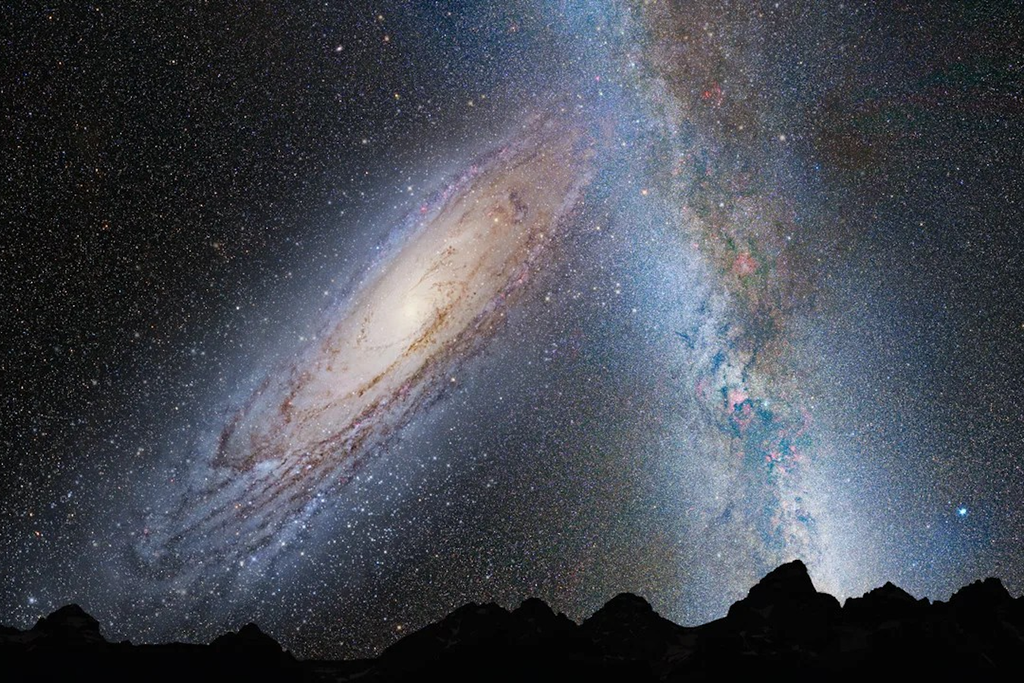
For thousands of years, we looked up at the night sky thinking of its eternity and immutability. Although it was not until a little over a century ago that we began to understand that our universe was bigger than we thought.
We now know that our Milky Way and the Andromeda galaxy attract each other gravitationally, promising to completely change the night sky for anyone left to observe. At the moment, Andromeda is approaching at about 120 kilometers per secondindicating that a close encounter is possible in the future.
However, the exact trajectory depends on its tangential speed, a fact that is difficult to measure; Even recent studies suggest that the collision is not an absolute certainty. The presence of satellite galaxies, such as the Large Magellanic Cloud, could alter the predicted course by up to 50%.
And even if the collision were to occur “head-on,” which almost never happens in the universe, and the galaxies merged, the stars would not collide with each other as we have been told in science fiction movies. This is because the distance between the stars is so immense that they will simply pass by.
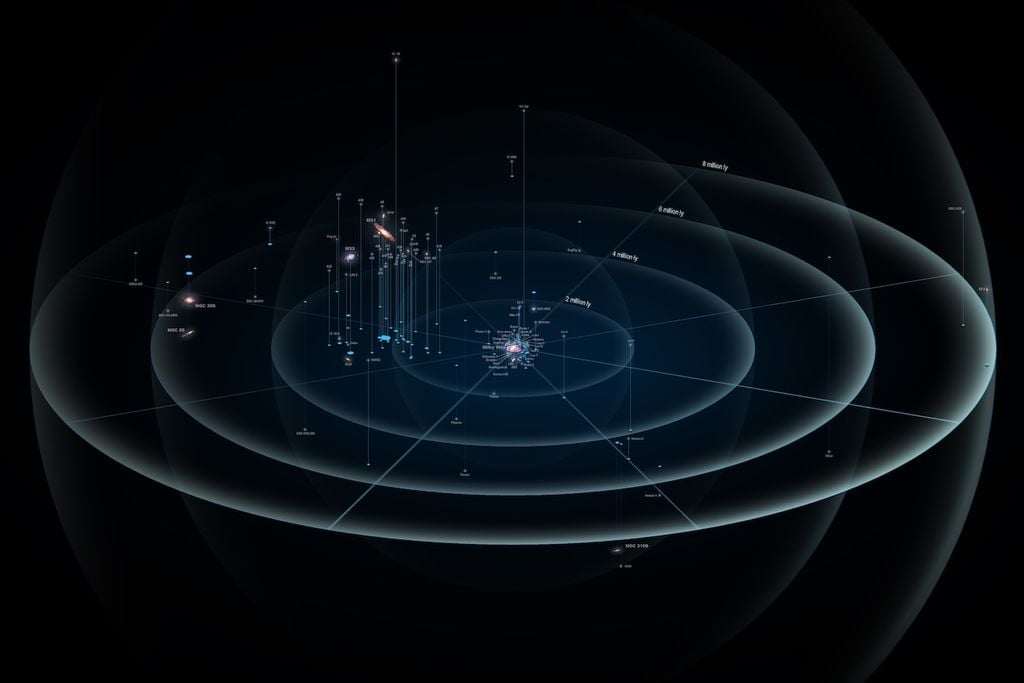
Galaxies are supermassive bodies, but composed of an almost absolute vacuum with respect to the stars. Although the structures merge and their shapes change drastically, the individual bodies, much smaller than the whole, will remain intact.
Chronicle of an announced hug
Scientists estimate that the first approach will occur in about 4 billion yearstime in which Andromeda will grow in the sky until it dominates the nights. It will be an unprecedented visual spectacle for any observer who inhabits our Solar System.
After the first encounter, the galaxies will separate again before definitively uniting in a complete fusion process that could take up to ten billion years to complete. Dark matter, present in both galaxies, will help slow down orbital movements.
The intergalactic medium acts as a sponge that absorbs the energy of the binary system. This accelerates the fall of one galaxy towards the other, making the Local Group of galaxies in which we live more compact. However, the size of the galactic halos is the most determining factor for speed.
The galactic halo is a diffuse, spherical structure that surrounds spiral galaxies, composed mainly of dark matter, a large number of old stars and very tenuous interstellar gas, which extends far beyond the disk.
We must not forget M33 and the Large Magellanic Cloud in this equation, since While M33 facilitates the union, the Magellanic Cloud pulls the other wayreducing the probability of impact. The balance between these forces will decide whether we will ultimately become a single entity.
The Sun will sail on the stellar tide
There is a possibility that we could be pulled into a tidal tail like passengers on the back of a roller coaster cart, which would take us away from the galactic center, sending us to the outermost and loneliest regions of the new system.
Another intriguing possibility is that Andromeda “steals” our Solar System before the merger. The models indicate a remote probability that the Sun will end up gravitationally bound to it and we would end up seeing the Milky Way as an external object.
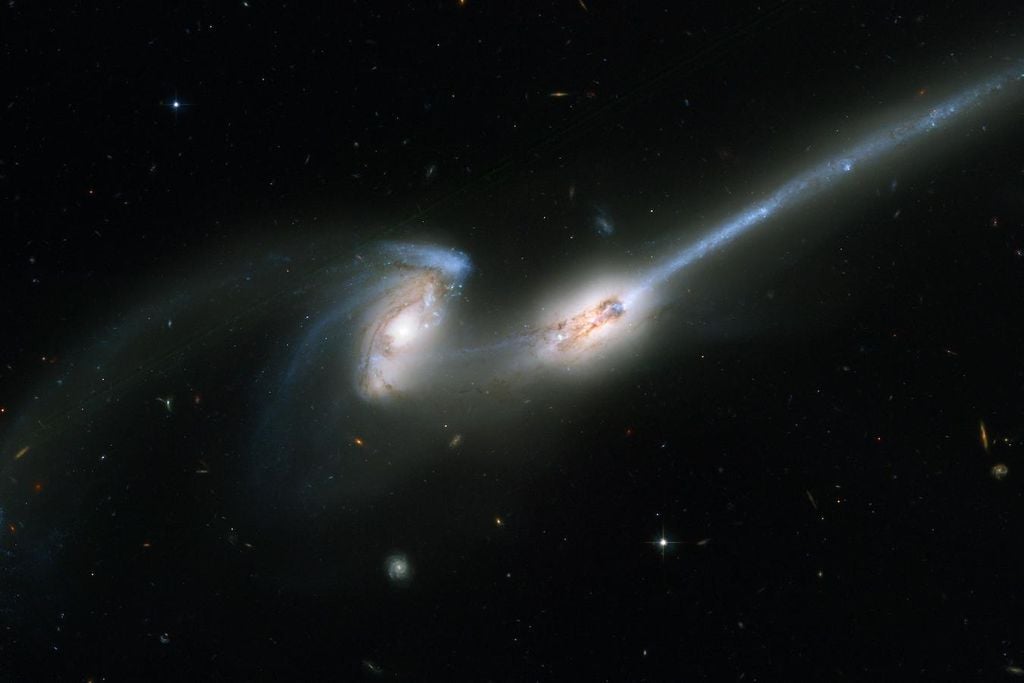
Fortunately, this encounter should not affect the stability of the inner planetary orbits. The greatest danger would come from a possible shower of comets from the Oort cloud, since disturbances due to nearby stars could launch these bodies into the interior of the system.
Something we must consider is that These events will coincide with the end of the Sun’s life. While the galaxies dance, our star will become a red giant, changing forever, so the cosmic destiny of the Earth will be linked to these simultaneous processes.
Milkomeda: a bleak future
The galaxy resulting from this collision It has been named by astronomers as Milkomeda. Unlike current spirals, it will have a much smoother elliptical or spheroidal morphology, in which the stars will move in random orbits, without an ordered disk.
Interestingly, a violent burst of star formation is not expected during the impact, because both galaxies currently have little gas available to create massive new stars. Rather, it will be a smooth transition to a mature galaxy, populated primarily by old stars.
In the heart of Milkomeda, supermassive black holes will also stage a final encounter: After forming a binary system, they will eventually merge, emitting powerful gravitational waves. An event that will mark the definitive end of the fusion of our new and colossal space home.
In a hundred billion years, Milkomeda will be all we can see, if we still exist, due to the accelerated expansion of the universe, which will cause galaxies not belonging to the Local Group to disappear behind the horizon, leaving us on a lonely island, surrounded by a dark and infinite abyss.

