

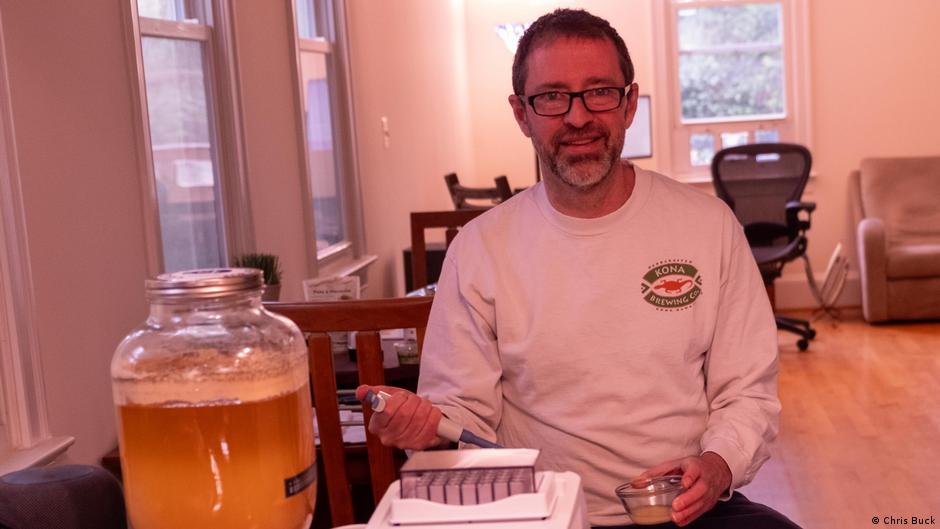
Beyond the conspiracy and anti-vaccine movements, many people are afraid of needles when getting a vaccine. But what would happen if instead of having to endure the slight pain of the puncture, the biological preparation could enter the body through a beer?
That is precisely the idea of Chris Buck, an American virologist at the National Cancer Institute (NCI) in Bethesda, Maryland, who has also been brewing home beer intermittently for 30 years.
These two facets crossed when, while researching a vaccine against polyomaviruses—a viral family associated with cancer and serious problems in immunodeficient people—he had an unconventional idea: a beer that works as a vaccine.
The NCI banned him from experimenting with beer in the workplace. But the institution can’t control his private life, so Buck founded Gusteau Research Corporationa nonprofit organization, and began working from home.
A home experiment
Along with his brother Andrew and other family members, Buck tried the beer-beef. Both assure that the preparation generated antibodies and that neither suffered side effects. Their results were shared on the data sharing platform Zenodo.orgalthough they have not been reviewed by other experts.
“The idea is, in reality, to take live yeast – which is what is used to make beer – and introduce a vaccine into it. In this way, the yeast is able to provoke an immune response,” explains Buck in statements reported by Smithsonian Magazine.
On his blog “Viruses Must Die“, where he published the recipe, Buck says that when he fed genetically modified brewer’s yeast to laboratory mice, “he was able to induce protective antibody responses against the virus he studied. The first thing I thought was, ‘Well, I can definitely do that at home.'”
Opposition from health authorities
So far, no other scientists have officially reviewed his work. In fact, a committee from the National Institute of Health opposed publishing the study on the prepublications platform. bioRxiv.org because it is a self-experiment.
In February of this year, Buck was placed on temporary paid suspension pending an investigation. The notification letter did not clarify the reasons, although it ruled out that it was a “disciplinary measure.”
Criticism from the scientific world
The specialists consulted by scientific media agree on the risks of the approach: “We cannot draw conclusions based on having tested this with two people,” says Michael Imperiale, a virologist at the University of Michigan, in statements collected by ScienceNews.
“I expressed my concern that it didn’t seem like a good idea to bypass that process,” he adds, referring to the rigorous safety testing required for vaccines for vulnerable patients.
Arthur Caplan, who headed the medical ethics department at New York University, was more direct: “This may be the worst time imaginable” to introduce a vaccine beer, especially in the face of a government and social groups hostile to vaccines.
Support from other colleagues
Bryce Chackerian, a virologist at the University of New Mexico Health Sciences Center, has mixed feelings. He is not concerned about the safety of the beer vaccine itself, but defends the traditional process: “I believe in the vaccine trial system. I think it is really important to ensure that the products that are administered to the population are safe and that we do not undermine public confidence in vaccines,” he says.
But he also recognizes the potential of the idea. If the polyomavirus vaccine manages to get past the stomach and interact with immune cells in the intestine, it could produce antibodies. And live yeast could serve as a carrier for other types of proteins.
“It’s a very exciting possibility because that would mean, in theory, that their findings are not limited to just this vaccine,” notes Chackerian.
There are already oral vaccines—rotavirus, cholera, polio—that manage to survive stomach acids and act in the intestine, which suggests that the idea of getting vaccinated by drinking something is not impossible.
Preston Estep, a geneticist and entrepreneur who developed his own nasal spray vaccine against COVID-19, shares the spirit of the approach: “It allows people to experience vaccines in a very simple approach, as if it were a comfort food or drink.”
Possible application for COVID, flu and others
Buck believes that, with adjustments, the yeast could be used to develop vaccines against COVID-19, H5N1 bird flu and cancers caused by HPV.
“This vaccine only serves to demonstrate the principle. Next on the agenda is COVID-19 and the flu, and probably the herpesviruses and the adenovirus. Any virus responsible for the common cold is now in our sights,” the virologist points out. London Times.
Possible patent as a food and not as a vaccine
It is also exploring whether its beer vaccine would need approval from the Food and Drug Administration (FDA), or if it could be distributed as food.
“Vaccines are medicines. We all know it. There is no way to hide or disguise vaccines. They must be considered as a medicine, but the fact that something is a medicine does not mean that it cannot also be a food,” he concludes.

