


Image source, Getty Images
-
- Author, Sandrine Lungumbu
- Author’s title, BBC World Service
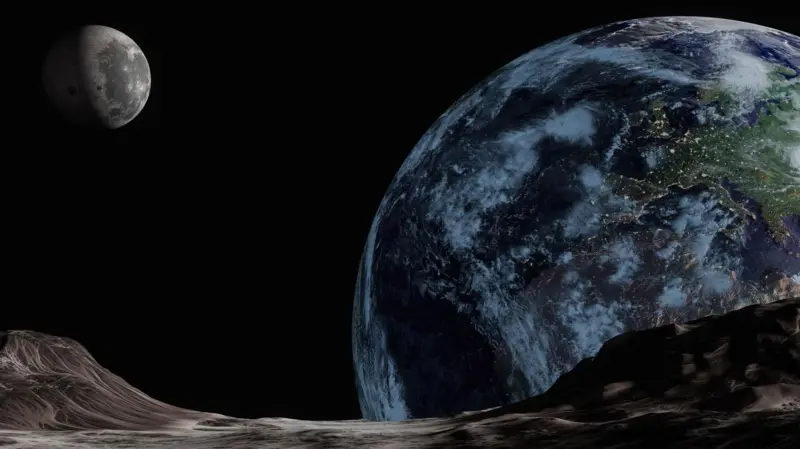
Astronomers have discovered that Earth has gained a new companion: an additional “moon”, which will be in orbit until approximately 2083.
But this is not the only celestial body close to our planet as we orbit the Sun.
The small asteroid called 2025 PN7 has been traveling almost in sync with Earth for decades.
“Quasi-moons are interesting because they don’t actually orbit our planets like the moon orbits the Earth, they’re just in our vicinity,” explains Dr. Jenifer Millard, an astronomer at Fifth Star Labs in Wales.
The asteroid is about 20 meters long.
“It’s not huge, it’s like a small office building. We believe it has been around for 60 years and has another 60 years left, calculated based on its current orbit,” Millard adds to the BBC.
The discovery was made by the Pan-STARRS observatory in Hawaii.
That observatory contains the telescopes that are used to detect near-Earth objects such as asteroids and comets.
Earth currently has a total of eight identified quasi-moons, an unknown number of mini-moons, and potentially two ghost moons.
However, none of them rival our planet’s only real satellite: the Moon.
What are “quasi-moons”?
Earth’s quasi-moons are so named because, from our point of view on Earth, they appear to orbit our planet as our moon does.
But if we look closer, we see that they are actually asteroids orbiting the sun along with the Earth.
“As they orbit the sun, they move in space following a very similar trajectory to that of the Earth. They appear to orbit around us because they stay very close, sometimes in front and sometimes behind, but in reality they are not gravitationally bound and that is the difference,” explains Millard.
However, as these asteroids trace their orbits, they are also slightly affected by Earth’s gravity, which pulls them towards it.
All of Earth’s known quasi-moons are temporary: their orbits can last decades or even more than a century.

Image source, Getty Images
Differences with “minimoons”
A minimoon, on the other hand, is an object that actually orbits a planet.
Earth’s minimoons are small asteroids temporarily captured by our planet’s gravity, remnants of the formation of the solar system or perhaps other space debris, and typically remain in orbit for less than a year.
They are tiny and difficult to detect: only four have been sighted and none are still orbiting the Earth today.
The last minimoon observed was in August 2024. Known as 2024 PT5, the asteroid measures approximately 10 meters long.
It is believed to come from the Arjuna asteroid belt, a group of space rocks that follow an Earth-like orbit around the Sun.
However, a more detailed analysis of its chemical composition seems to suggest that 2024 PT5 could actually be a fragment of our own moon, ejected after an asteroid impact long ago.
It spent only a few months in the vicinity of Earth before returning to the asteroid belt from which it came.

Image source, Getty Images
ghost moons
Ghost moons are, appropriately, the most mysterious of the three types.
They are believed to be spiraling dust clouds that share the Earth’s orbit, staying ahead or behind the Earth in its orbit around the Sun, but there is still no broad scientific consensus on their actual existence.
However, Millard finds the concept credible.
“There’s a lot of dust in space. There are interplanetary dust particles, so I wouldn’t be surprised if there was dust trapped in stable gravitational points around Earth’s orbit,” he says.
Are quasi-moons and mini-moons dangerous?
Despite their proximity in astronomical terms, these objects never come close enough to pose a danger.
Even at their closest point, they remain several times farther away than the Moon.
In spatial terms, that’s considered close, but in reality, there’s nothing to worry about.
“It’s not like they’re coming screaming out of the dark. If they came at us, it would be in slow motion; we’d see it coming and have enough warning to deal with it,” Millard explains.
What other planets have quasi-moons?

Image source, Getty Images
Only in recent decades have telescopes become sensitive enough to detect these faint and elusive asteroids.
They exist right on the edge of what current technology can detect in terms of brightness.
In addition to these advances, computer improvements have also made it possible to model their movements and confirm that these mysterious objects are, in fact, quasi-moons.
“It’s not an unusual phenomenon, they’re just very difficult to detect,” says Millard. “If they are difficult to detect near Earth, imagine how difficult it is to find them in other parts of the solar system.”
Quasi-moons have so far been observed around Jupiter, Venus, Saturn, Neptune and Pluto, and more may be found in the future.
“The solar system remains a very active and dynamic place. It is not dead or static, but everything is in constant motion,” he adds.

Subscribe here to our new newsletter to receive a selection of our best content of the week every Friday.
And remember that you can receive notifications in our app. Download the latest version and activate them.

