


The James Webb Space Telescope has made a super-detailed cosmic map, which includes 13.7 billion years of the Universe. No other telescope had been able to reach so far with such precision. Hubble tried, but didn’t achieve that much. What was invisible to him, now appears majestic before our eyes.
Further and more precise. This new cosmic map has been possible thanks to the work of a team of scientists from the University of California, Riverside. They have been in charge of analyzing a catalog known as COSMOS-Web, which includes the most extensive compilation of data from this telescope to date. In a space of sky equivalent to three full moons, they have seen what until now was invisible.
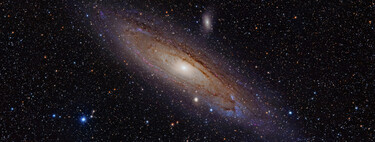
James Webb’s superpowers. We know that the Universe is expanding, so galaxies are moving further away, like dots painted on a balloon that is inflating more and more. Since light is a wave, the wave emitted by these galaxies also stretches. This means longer wavelengths that, in the electromagnetic spectrum, correspond to infrared. This is known as redshift.
The older and more distant a galaxy is, the more of that stretching it will have experienced, so there will be more redshift. Therefore, in order to detect very old galaxies, it is necessary to use instruments capable of detecting these infrared radiations very well. That’s where James Webb comes into play, as he has an instrument called NirCAM, whose specialty is precisely that. Furthermore, thanks to the size of its mirrors, with an area 7 times larger than that of Hubble’s mirrors, much more light can be captured and more precise images obtained.
Lifting the cosmic veil. James Webb also has the ability to peer through the clouds of gas and dust that normally surround younger stars and planets. It’s something Hubble can’t do either, so many more structures are revealed that were invisible to its predecessor.
What Hubble didn’t see. Unlike James Webb, Hubble is specialized in detecting mostly the visible and ultraviolet spectrum of light. For this reason, the oldest structures in the Universe have gone unnoticed. By comparing the James Webb cosmic map with the more precise one made with Hubble, it has been seen that what previously seemed like a single structure is actually many. The sharpness of certain structures that seemed very diffuse has also been increased. In short, the resolution has increased. Distances are better measured and some structures are better distinguished from others.
We can all see it. The catalog that has just been created contains 164,000 galaxies and a video that shows the movement they have experienced for 13.7 billion years. It is the furthest journey that has been made in the universe with one of these maps. And the best thing is that all this information is open access. Therefore, anyone can access it. Scientists who wish to do so will be able to study it, in search of data that may have gone unnoticed by researchers at the University of California.
In short, teamwork is sought. Just as James Webb works in tandem with Hubble and will soon do so with Roman, scientists on Earth should do the same.
Image | Image taken by James Webb that is not part of the map (NASA)
In Xataka | We have been studying the planets of TRAPPIST-1 for years with great hope. James Webb just knocked it down

